
What to do right now when you suspect a hidden leak
Most hidden leaks do their damage slowly, but a few turn into floods. Spend the first few minutes on containment, then call the 24/7 line and describe what you see, hear and smell.
- Find the main shutoff.It is usually where the water line enters the house, often near the water heater or in a utility room. Turn it clockwise until it stops.
- Kill power near water.If water is dripping from a light fixture or pooling around outlets, switch off that breaker. Do not stand in water to do it.
- Catch and photograph.Put a bucket under a ceiling drip and take photos of every wet surface. Your insurer will ask for them later.
- Leave the walls alone.Cutting a hole at a guess often misses the leak and adds a repair bill. Instruments find it from outside the wall.
How we find a leak without tearing out walls
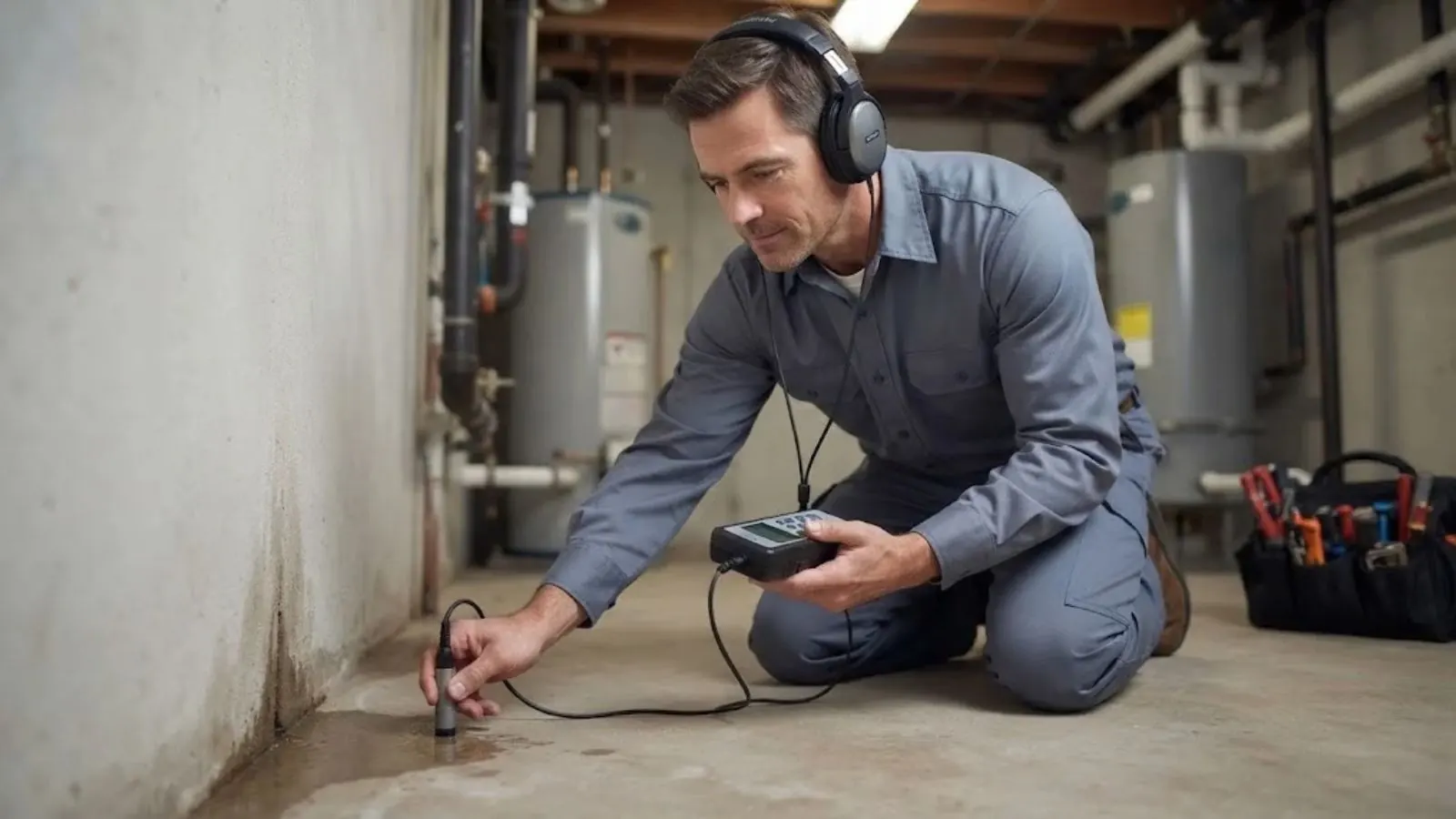
We do not guess where a buried or concealed leak is. We narrow it down with a sequence of tests, and each tool answers a different question. The first test is usually the simplest: is water actually escaping, and on which side of the house?
| Method | What it tells us | Where it falls short |
|---|---|---|
| Pressure test with a gauge | Whether a closed section of supply line holds pressure or bleeds down | Says a leak exists, not exactly where |
| Acoustic listening | The hiss or drip of pressurized water in pipe, picked up through floors, walls and soil | Hard to hear over traffic, running appliances or very small leaks |
| Thermal imaging | Temperature differences from hot-line leaks and wet building material | Cold-line leaks may show nothing, and it only sees surfaces |
| Tracer gas | A safe gas pushed into the emptied line escapes at the leak and is sensed above it | Needs the line isolated and drained, so it is a later step |
| Line locator | The path and depth of buried pipe, so we listen in the right place | Locates the pipe, not the leak itself |
| Moisture meter | How far dampness has spread in drywall, wood and subfloor | Shows wet material, which is not always the source |
Thermal imaging and listening work best together. The camera shows where a warm line runs wet, and the microphone confirms whether that spot is actually the source. Once we are sure, we mark it and show you before anything is opened.
Water meter still running or a high bill you cannot explain
A meter that moves when nobody is using water is the clearest sign of a leak. A high bill alone is weaker evidence, because sprinklers, guests and a stuck toilet flapper can all do it. The meter test separates those cases.
Stop every use inside
Close faucets, pause the dishwasher and washer, and make sure no one flushes. Check the ice maker and any softener that may be recharging.
Stop the irrigation
Close the secondary water valve or turn the sprinkler controller off so yard water does not confuse the reading.
Read the dial or flow indicator
Most meters have a small triangle or wheel that spins at the slightest flow. If it moves with everything off, water is going somewhere.
Close the house shutoff and look again
If the dial stops, the leak is inside the house side. If it keeps moving, the leak is between the meter and the shutoff, usually in the buried line.
Riverton's city page says the city owns the water line up to and including the meter, and the property owner owns the line from the meter to the home. Leave the meter box closed, and do not pry at it. For a bill question or a possible meter fault, the Utility Billing Office at City Hall, 12830 S Redwood Road, is the right desk. We cannot promise any bill credit, because we did not find a published leak adjustment policy.
Slab leak signs: warm floor, hissing and wet carpet
A slab leak is a pressurized water line leaking under or inside a concrete floor. Only homes built on a slab have the exposure, so if yours has a basement or full crawlspace, look at those sections instead. The signs can be subtle for weeks.
A floor spot that feels warm
A leaking hot line heats the concrete above it. Walk barefoot and compare.
Running-water sound at night
A faint hiss or trickle with every fixture closed points to a pressurized line.
Damp carpet or lifting flooring
Water finds the seams. Wet baseboard at the edge of a room often traces back to a line below.
A meter that moves with the house shut off
Run the meter test above. A moving dial with no known use is the strongest clue.
Low hot-water pressure
Pressure that drops on the hot side only suggests a loss on that line.
How a slab leak gets located and repaired
We isolate each line with a pressure test to learn which one is losing water. Then we listen along the floor and use thermal imaging to mark the leak to a small area. Only that spot is opened.
- Spot repair:break the concrete at the leak and fix the pipe. This is the least disruptive option when the rest of the line is sound.
- Reroute:abandon the leaking line and run a new one through walls or the attic. It costs more up front but avoids reopening the slab.
- Repipe:replace the failing lines when the pipe is worn throughout. Repeat leaks in the same home point this way, and our whole-house repiping page explains what that involves.
Stain on the ceiling or damp wall: where is it coming from?
Water travels along framing before it shows itself, so the stain is rarely under the leak. A brown ring on a ceiling can come from a bathroom above, a roof penetration, an air handler drain or a supply line in the wall.
Start by asking when it appears. A stain that grows only after showers points to a tub, shower valve or drain above. One that grows after rain points to the roof, which is not plumbing. A stain that grows constantly, rain or shine, points to a pressurized line.
- A bubbling or soft drywall spot means water has been present for days, so cut power to nearby outlets.
- Mold smell with no visible water suggests a slow leak inside the wall cavity.
- Sudden loud dripping in a ceiling is a reason to shut the main valve before anything else.
- A tub overflow gasket or shower pan that leaks only during use is a fixture problem, not a hidden line.
Thermal imaging maps the wet area, a moisture meter shows how far it has spread, and a pressure test tells us whether the supply is involved. Many wall leaks turn out to be a shower valve connection or a failed supply fitting, which is a small, targeted repair once found.
Hearing water but cannot see it?
Call the 24/7 line and describe the sound, the stain or the meter reading. We will tell you whether it needs a visit today and what to shut off in the meantime.
Under-house and crawlspace leaks
If your home has a crawlspace or a basement, leaks below the main floor can run for a long time unseen. You may notice a musty smell, sagging insulation, a floor that feels soft, or a meter that moves when nothing is on.
Access matters. We look at exposed supply lines, drain lines and fittings first, because a dripping joint is the common find. When pipe runs behind finished walls or under a slab, we listen and image from above instead of crawling and cutting.
Standing water is a mixed problem. It may be a supply leak, a drain leak, or groundwater. If it smells like sewage, keep out and read our sewer camera inspection page before touching anything. The Utah Geological Survey has mapped shallow groundwater in part of Riverton, so we always check the plumbing first and rule it out before blaming the ground.
Buried water line leaks between the meter and the house
When the meter keeps moving even with the house shutoff closed, the loss is in the buried line you own. Signs outside include a patch of soggy lawn with no sprinkler nearby, a dip in the yard, or water surfacing in a dry week.
We locate the pipe, listen along its path, and confirm with a pressure test on that section. Then you choose between a spot repair and replacing the run, which our water line repair page explains. Call Blue Stakes at 811 before anyone digs. Notice is required before excavation, and online requests are accepted around the clock.
Sprinkler, meter-box and pool leaks in Riverton yards
Riverton runs a separate secondary water system for irrigation. The city asks residents to shut their secondary valves by March 15, and activation is tentatively set for May 1. A leak that appears right after startup is often a cracked riser, a broken head or a buried irrigation line that froze over winter.
The city says most calls about spraying water turn out to be sprinkler line breaks, which you can stop at your property's ball valve. Water pooling around the meter box is a different matter, so call us or the city rather than digging there. If you have a pool or spa that loses water, we can tell you whether the loss is in the plumbing lines, though the shell is a different trade.
What Riverton homes add to the leak picture
A split in who owns the line
The city owns the pipe through the meter and you own everything after it. That makes the meter test the first fork in the road.
Winter freezes
Salt Lake City airport normals show about 112 days a year with a low at or below 32F, and a January normal low of 24.2F. Riverton differs a little, but exposed lines in garages and outer walls still carry that risk.
Mineral-heavy water
Riverton's 2022 water quality report lists average hardness of about 190 mg/L, around 11 grains per gallon. Scale can build in fittings, so check your tap and look at valves and supply connectors.
Two water systems
Culinary and secondary lines run separately, so a leak in a yard line is not always your house supply. Identifying which one is losing water saves digging.
What you can check yourself and when to stop
Safe to check yourself
- Run the meter test with all water off
- Look under sinks and behind toilets for damp supply lines
- Check the water heater base and nearby floor
- Close the secondary valve and see if the dial settles
- Photograph stains and note when they grow
Call a licensed plumber
- The dial moves after the house shutoff is closed
- Warm floor spots or hissing you cannot trace
- Water in a ceiling or behind drywall
- Wet soil near the meter or along the service line
- Any shutoff valve that will not close
Leak detection cost: what shapes the price
Where the pipe runs
A line under a slab or deep in the yard takes more setup than a supply line in an open crawlspace.
How many tests are needed
A simple meter test may confirm the problem. Pressure isolation, tracer gas and imaging add steps when the first tests do not narrow it.
Access and finish work
Opening drywall or concrete means patching afterward, and finished surfaces cost more to restore.
Repair path you choose
Spot repair, reroute and repipe have very different scopes once the leak is found.
After-hours dispatch
Night or weekend calls may carry a different rate than a scheduled daytime visit.
Homeowners policies often cover sudden water damage but usually not slow leaks or wear, so check your policy and keep the photos. Call us for a real number once you describe the situation, and we will state a clear price before work starts.
Rules and sources behind this page
According to Riverton City's water page, the city is responsible for the line up to and including the meter, and the owner is responsible from the meter to the home. That split decides who pays when a locator finds the leak in the front yard.
Digging near a buried line needs a call to Blue Stakes of Utah at 811 first. Notice is counted in business days, and a ticket stays valid 21 days. Repairs that open walls or lines follow the IPC. Utah Code 15A-2-103 adopts the 2024 International Plumbing Code (IPC) as the state plumbing code, effective July 1, 2026, with Utah amendments on top.
Leak detection questions from Riverton homeowners
Yes. Our 24/7 emergency line is staffed around the clock, and same-day appointments are available when the schedule allows. Shut the main valve first, then call and tell us what you see.
We also dispatch to South Jordan, which borders Riverton to the north.
Close the house shutoff and watch the dial. If it stops, the leak is inside the house. If it keeps moving, the loss is in the buried line from the meter to the home.
Either way, we use listening gear and pressure testing to narrow it down before digging.
Irrigation, a running toilet and guests are common causes, and so are hidden leaks. Do the meter test with everything off to tell them apart. For a billing or meter question, contact the city Utility Billing Office.
We isolate each line with a pressure test, then listen along the floor and use thermal imaging to mark a small area. Only that patch is opened for repair, and you see the finding before work begins.
No. Radiant heat, ducts under the floor or sunlight can warm concrete. A warm spot together with a moving meter or running-water sound is a stronger sign. Call and we will help sort it out.
Check timing. Growth after rain points to the roof. Growth after showers points to a bathroom above. Growth around the clock points to a pressurized line, and a burst pipe repair visit may be needed if it is dripping hard.
Yes, we can pressure test and listen along irrigation runs. If the city has shut off secondary water for the season, we can still test the line with the valve closed or call out for a scheduled shutoff.
Some policies cover finding the source of a sudden covered loss, and many exclude slow leaks and wear. Ask your insurer before the visit, and keep photos and our written findings for the claim.