
Who owns the water line in Riverton, and who fixes what
Riverton City is responsible for the water line on the street side up to and including the meter, which sits in the park strip. The property owner is responsible for the line from the meter to the home. That split decides who you call.
| What you see | Likely side | First move |
|---|---|---|
| Water bubbling up at the street edge of the meter | City side | Call the city water line, do not dig |
| Soggy lawn between meter and house, meter moving with house shutoff closed | Owner side | Call us, we locate then repair |
| Spraying water in a planter or lawn | Often a sprinkler line | Close that line's ball valve, then call if it persists |
| No water or very low pressure at every tap | Either side | Check meter and shutoff, then call |
The city does not diagnose responsibility by phone and needs an on-site look, so we treat the meter as the dividing line. After hours, the city lists on-call numbers of 801-558-1814 or 801-254-0704. For a major break or flooding during business hours, it lists 801-208-3113. Leave the meter box closed.
When a water line break is an emergency
Water gushing in the yard, a sudden loss of pressure with a wet driveway, or a meter that spins with the house shut off all call for a fast response. We dispatch same-day when available, and after hours through the 24/7 line.
- Close the main shutoff at the house to stop water flowing from the meter.
- Keep kids and pets away from soft, undermined ground where a sinkhole could form.
- Do not dig by hand or with equipment. Utilities may be buried nearby, and Blue Stakes asks you to call 811 first.
- Run a faucet briefly to confirm the house is actually without water, so you can tell us what you see.
Signs the service line is leaking
Meter moves with everything off
Close the house shutoff and watch the dial. If it still moves, the leak is in the buried line.
Wet patch with no sprinkler
A green strip or soggy spot in dry weather may sit directly above the line.
Sudden pressure drop
A growing break pulls water out before it reaches the house.
Rushing sound near the meter
Listen at the shutoff or a hose bib while no fixtures run.
A bill that climbed
A steady leak adds up long before anything shows on the surface.
For leaks that are hard to pinpoint, we use acoustic listening and a line locator before any digging begins. Our leak detection page explains the instruments. We never guess where to open the ground.
Trench repair, trenchless and replacement
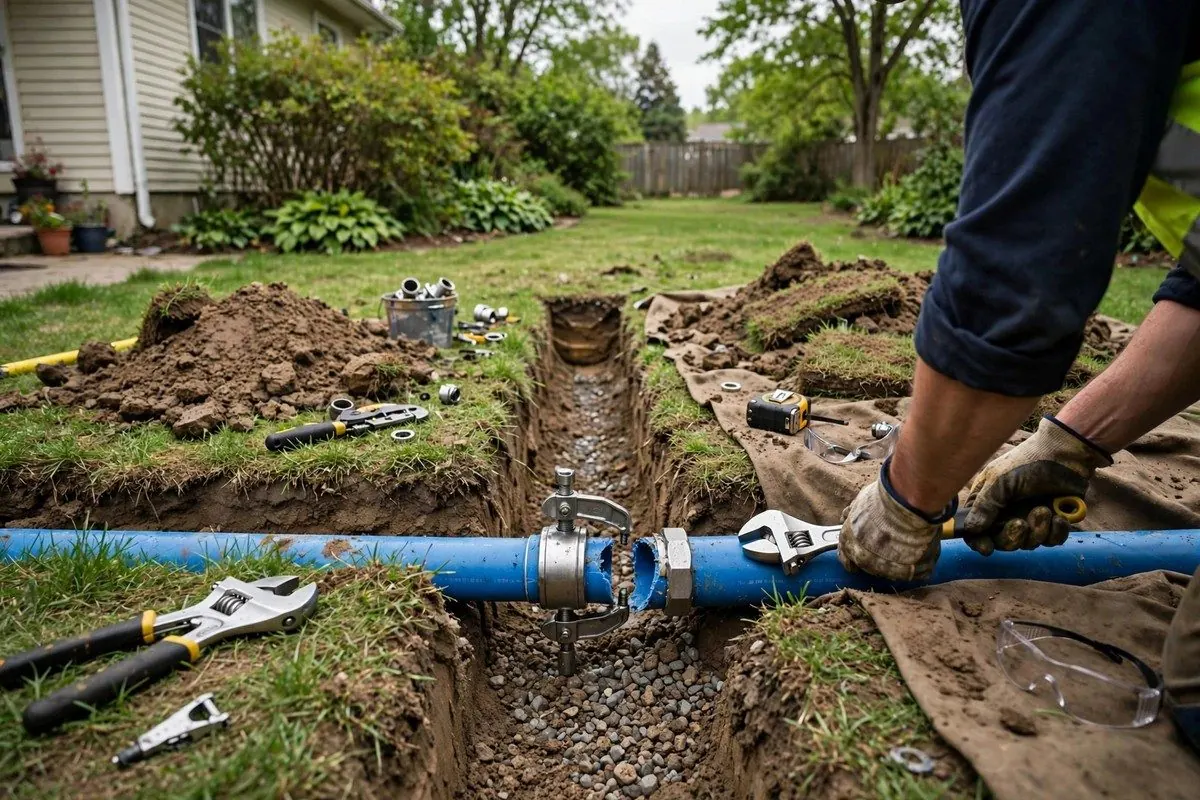
Once the leak is located, the choice is how much pipe to replace and how to reach it. The right answer depends on the condition of the line, what sits above it and where it enters the house.
Open trench
- Fastest path to a visible, tested repair
- Lets us replace a short bad section or the whole run
- Lawn, concrete or landscaping must be restored
- Best when the break is shallow and accessible
Trenchless
- Fewer holes, less damage to driveways and landscaping
- Suits long runs under hardscape
- Needs a pipe path that can be pulled or burst
- Not every line or soil condition allows it
A spot repair makes sense if the pipe is otherwise sound and the break is a single failed joint or crush. If the line shows repeated leaks, corrosion or poor material, replacing the run is cheaper over time than reopening the same yard. Water main replacement from the street is city work, so we stop at the meter.
Before any excavation, we call Blue Stakes at 811. Notice must be given before digging, and Blue Stakes recommends allowing several business days, so we plan the schedule around the ticket.
Wet yard and a spinning meter?
Call the 24/7 line before you dig. We will help you tell city side from owner side and send a plumber to locate the break.
Low water pressure: is it the line or the house?
Low pressure does not always mean a broken service line. It can come from a partly closed valve, clogged aerators, a failing pressure regulator if the home has one, or a leak somewhere along the line. The tests are simple, and they save you from paying for the wrong repair.
Compare hot and cold
If only hot water is weak, look at the water heater, not the service line.
Test several fixtures
One weak faucet usually means a clogged aerator or cartridge. All fixtures weak means the problem is upstream.
Read a gauge at the hose bib
We attach a pressure gauge to an outdoor spigot, read static pressure, then open a fixture and watch how far it drops.
Check the meter
A moving dial with the house closed turns a pressure complaint into a leak search.
Old corroded steel lines can also lose flow as they scale inside. If the service line is metal and failing across its length, consider our repiping page, because a patched section may not fix the whole flow problem.
Backflow assemblies and your water line
Backflow assemblies keep irrigation or other water from flowing backward into the drinking supply. According to the city's backflow program, assemblies are tested when installed, repaired or relocated, then yearly by a certified tester, paid for by the owner, with results reported to the city.
If your irrigation connects to the culinary line, the city says it needs a reduced pressure principle assembly, often called an RPZ. A line repair that disturbs the assembly may trigger a retest, so tell us whether your yard has one. Ask when you call whether we can handle the testing for you.
What a water line repair costs
Length of pipe replaced
A short spot repair and a full meter-to-house replacement are very different jobs.
Depth and soil
Deeper trenches and tougher ground mean more labor and shoring.
Surface restoration
Sod and gravel are easier to restore than concrete, pavers or landscaping.
Trench or trenchless
Each method has its own equipment and set-up, and neither is always cheaper.
Fittings and shutoffs
Replacing an old shutoff or adding a new one at the house changes materials and time.
Homeowners policies often cover sudden burst-pipe damage but usually not slow leaks or wear. Check your policy before you decide. Call us for a real number, and we state a clear price before work starts.
Water service line questions
Yes. The 24/7 emergency line is open at all hours, and we also dispatch to nearby areas such as Bluffdale. If water is spraying, close the house shutoff and call.
Riverton City is responsible up to and including the meter, and you are responsible from the meter to the home. Water bubbling at the meter box is the city's, while a wet lawn between the meter and house is usually yours. The city needs to inspect on site to settle it.
Check whether it is every tap or just one. Then check the meter with the house closed. A pressure gauge on an outdoor spigot gives us a reading, and the pattern tells us whether the cause is the line, a valve or a fixture.
Either, depending on what we find. If the pipe is sound, a spot repair works. If it is corroded or has failed more than once, replacing the run saves digging the same yard again.
Sometimes. Trenchless methods can replace a run with limited openings, but they need a suitable path. We check with a locator and tell you honestly which approach fits.
The city requires a certified tester, paid by the owner, at install, repair or relocation and then yearly. Ask us about testing when you call. Any certified tester can do it.
Yes, and we do it as part of the job. Blue Stakes marks public utilities so nobody hits a gas or electric line. A ticket needs several business days, so the repair schedule accounts for it.