
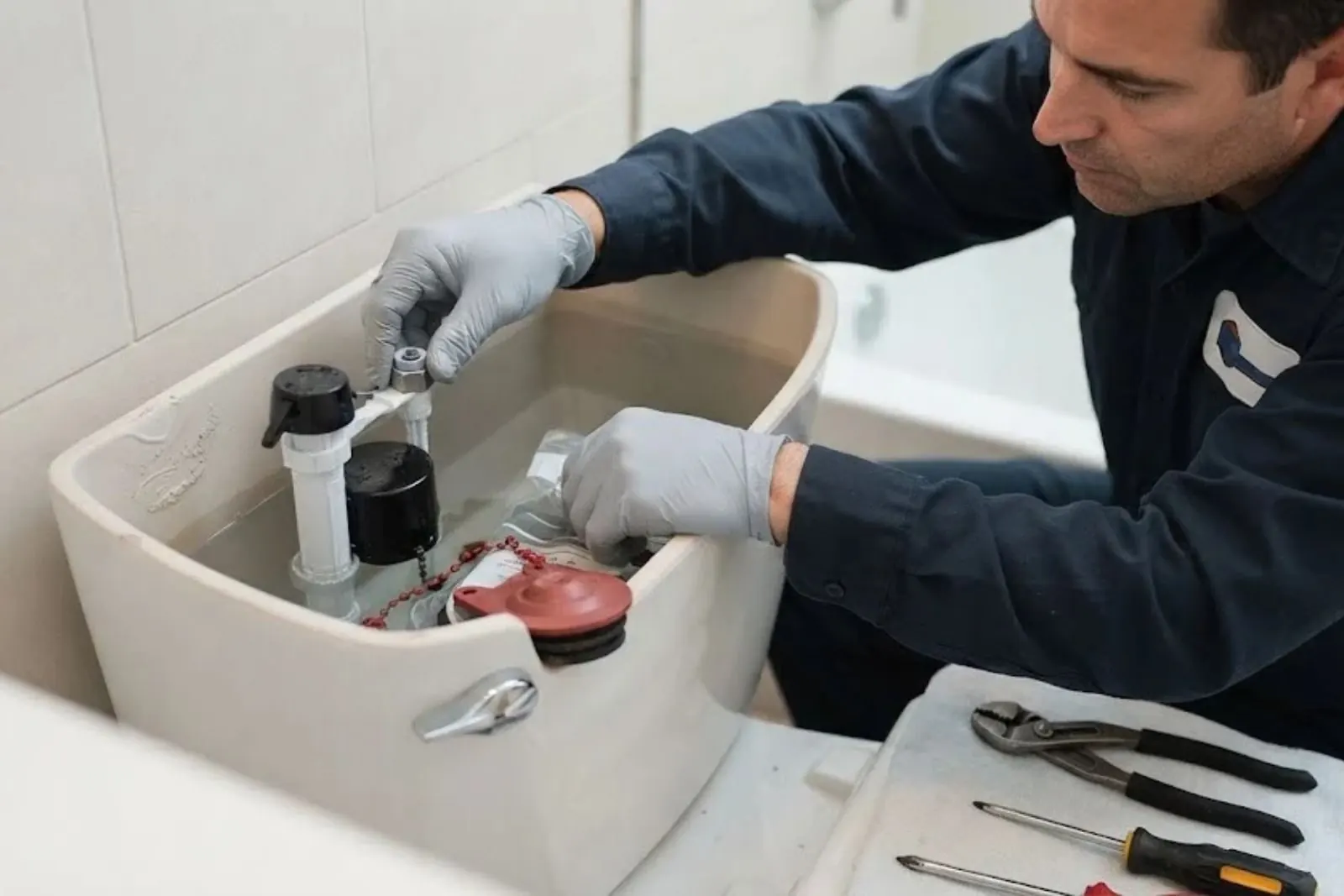
When an overflowing toilet is an emergency
Water rising to the rim is the emergency. Water seeping slowly around the base is urgent but gives you a little more time. Either way, the supply valve behind the toilet and your own hands are the fastest tools you have.
Do not keep flushing to see if it clears. Each flush sends another tank of water into a bowl that has nowhere to put it.
Stop the flush
Lift the tank lid and push the rubber flapper down into its seat, or lift the float arm to stop the tank from refilling.
Close the supply valve
Turn the oval handle on the small pipe behind the toilet clockwise. If it will not turn, do not force it. Use the main shutoff instead.
Protect the floor
Lay towels along the base and keep family members and pets out of any water that came from the bowl.
Check the other drains
Run a nearby sink for a few seconds. If it gurgles or the tub bubbles, the blockage is probably past this toilet, and you should call us right away.
Clog or broken part? Read the symptom
Most toilet calls fall into two families. One is a blockage, where water cannot leave the bowl. The other is a mechanical failure, where something inside the tank or at the floor no longer does its job. The fixes are completely different, so it pays to sort them first.
| What you notice | Most likely cause | What a plumber checks |
|---|---|---|
| Bowl fills high, drains slowly | Blockage in the trap or closet bend | Closet auger pass, then flow test with a measured bucket of water |
| Tank refills every few minutes with no flush | Worn flapper or fill valve leaking into the bowl | Dye tablet in the tank, flapper seat, fill valve shutoff |
| Weak flush, quiet bubbling | Clogged rim jets or partial blockage | Rim holes, trap passage, vent and nearby drains |
| Water pooling at the base | Failed wax ring or cracked flange | Rock test, bolt tightness, flange height and condition |
| Toilet and tub both back up | Blockage in the branch or main line | Cleanout inspection, camera if the blockage keeps returning |
A good rule of thumb: if only this toilet misbehaves, the cause is usually at the toilet. If two fixtures act up together, the cause is in the pipe they share.
Running, ghost flushing and weak flush: the tank parts
Inside the tank, three parts do nearly all the work: the fill valve, the flapper and the flush handle linkage. When one wears, the toilet tells you in a recognizable way.
Hissing or running water
Usually a fill valve that no longer shuts off cleanly, or an overflow tube set too high. Water spills down the tube all day.
Ghost flushing
The bowl refills by itself every so often. The flapper is leaking slowly, and the tank drops until the fill valve kicks in.
Handle needs a hold
A stretched chain or bent arm lifts the flapper only part way, so the tank empties too slowly to clear the bowl.
Tank sweats or drips outside
Condensation on cold days, or a worn tank-to-bowl gasket or supply connector. A dry paper towel held to each joint shows which.
Replacing a flapper or fill valve is a job many homeowners handle. We step in when parts are corroded, shutoff valves seize, or the toilet has been fixed twice and still runs.
Toilet leaking or won't stop running?
Call the 24/7 line and describe what you see. We will tell you whether it needs a visit tonight or can wait for a same-day appointment when available.
Leak at the base: wax ring and flange
A toilet sits on a wax or rubber ring that seals the bowl outlet to the drain flange in the floor. When that seal fails, wastewater seeps out at the base with every flush. You may notice a damp stain on the ceiling below, a musty smell, or a toilet that rocks.
Replacing the ring means shutting the water off, draining the tank, lifting the toilet and cleaning the old wax away. The flange gets inspected at the same time. A flange that is cracked, rusted or sitting below the finished floor will not hold a new ring for long, and it needs repair before the toilet goes back down.
If the subfloor around the flange feels soft, stop using the toilet. Rot under a bathroom floor spreads quietly.
Hard water, fill valves and what Riverton homeowners see
Riverton's 2022 water quality report lists average hardness of about 190 mg/L, roughly 11 grains per gallon. Minerals from water like that can crust fill valve seats and flapper edges over time, which is one reason a toilet starts running. Test your tap or ask the Riverton water division for its latest annual report to see where your supply sits.
If you see white scale around the fill valve or in the tank, a new flapper and valve usually restore a clean seal.
Flushing guidance from JBID
Jordan Basin Improvement District asks residents not to flush diapers or other disposable hygiene products. If you flushed one and the toilet clogged, mention it when you call.
The cleanout test
JBID says standing water at the home's cleanout points to a blockage between the house and the sewer main. Clear water at the cleanout points to your own plumbing. Do not open it if sewage is already rising.
Who owns what
JBID maintains the sewer main. The private line from your home to the main is the homeowner's. A toilet clog that returns weekly may be a lateral problem, which we cover on the sewer line repair page.
Winter bathrooms
Salt Lake City airport normals show about 112 days a year with a low at or below 32F. Riverton differs a little, but an unheated bathroom is worth watching for frozen supply lines.
Repair the toilet or replace it?
Repair makes sense when
- The bowl and tank are sound and the problem is one worn part
- The toilet flushes well when it is working
- Only the wax ring or flange needs attention
- You like the toilet and replacement parts are easy to match
Replace when
- The bowl or tank has a hairline crack that weeps water
- It clogs often even with a clear drain line
- The china is stained with deep mineral buildup that will not clean
- You are already pulling it for a flange or floor repair
Replacement is also the time to fix small annoyances, like a toilet set too close to the wall or a bowl that is hard to clean.
How a toilet installation goes
Confirm the rough-in
We measure from the wall to the flange center so the new toilet fits the space you have.
Remove the old toilet
The supply is shut off, the tank and bowl are drained, and the toilet is lifted away. A rag plugs the flange to block sewer gas.
Inspect the flange and floor
We look for cracks, rust and a floor that is solid, and repair what we find.
Set and seal
A new ring, new bolts and a level seat. Tightening goes in alternate turns so the bowl does not crack.
Connect and test
A new supply line goes on, then several flushes while we watch every joint and look for a rock or a drip.
What toilet repair costs
Which part failed
Tank parts are small repairs. A seal, flange or cracked bowl means more labor.
Floor and flange condition
Rot or a broken flange adds carpentry or pipe work beneath the toilet.
Shutoff valve condition
A seized or leaking supply stop must be replaced before the toilet can be worked on.
A clog behind the toilet
If the drain line is the problem, drain work is priced separately from toilet work.
New toilet and haul-away
Replacement adds the unit you choose, a new supply line and removal of the old toilet.
Homeowners policies often cover sudden water damage but usually not slow leaks or wear, and standard policies often exclude sewer backup, so check your policy. Call the 24/7 line and we will give you a clear price before work starts.
Toilet questions we hear most
Yes. Our emergency line runs 24/7, and the plumbers who answer can tell you what to shut off while you wait. Same-day appointments are offered when available for repairs that can hold until morning.
If the water is already rising, close the valve behind the toilet before you call.
A flapper that no longer seals lets tank water leak into the bowl, and the fill valve tops it back up. Drop a dye tablet in the tank and wait without flushing. Color in the bowl confirms the leak.
The wax ring has probably lost its seal, or the flange beneath is damaged. Do not keep using it, because every flush leaks onto the subfloor. If a bathroom on the main floor is above a finished room, check the ceiling below for stains.
Stop using every fixture. The blockage is likely in a shared branch or the main line, and a plunger will not reach it. Read about sewer line cleaning, then call us.
It builds scale on fill valve seats and flapper edges, which can cause running. Riverton's 2022 report lists average hardness of about 190 mg/L, so mineral buildup is plausible. Cleaning or replacing the parts is usually enough.
Yes. We confirm the rough-in size, check the flange and floor, set the toilet on a new seal and test it. Bring your choice or ask us to recommend a size that fits.
Toilets and sinks share a bathroom but not the same fixes. For drips under a vanity or a faucet that will not shut off, see faucet repair.