Signs a cable alone won't solve the problem
Most people call about jetting after a snake has already failed. Sometimes a plumber ran a cable and it caught partway down the line. Sometimes the drain worked for a month and then slowed again.
Back again in weeks
A cable pokes a hole through the clog but leaves a coating on the pipe wall. New debris sticks to it.
Cable stalls at one spot
A stall may mean roots, a heavy grease mass, a joint that has shifted, or a break. A camera tells us which.
Several fixtures drain slowly
When the tub, toilet and washer all slow down together, the building drain or lateral is narrowing.
Gurgling from the main
Air pushed back through traps often shows up before water does. Treat it as a warning, not a quirk.
Roots seen on a past camera look
Roots return unless the opening they entered is dealt with, so jetting is maintenance, not a cure.
Jetting versus cabling: what actually differs
| Question | Cable machine | Hydro jetter |
|---|---|---|
| How does it clear the pipe? | Spinning steel cable pokes through or cuts the blockage | Pressurized water scours the whole pipe wall |
| Best for | Single soft clogs and quick branch-line fixes | Grease film, scale, silt and root growth along a run |
| What it leaves behind | A narrow channel with residue on the walls | A cleaner bore, with debris flushed downstream |
| Risk to weak pipe | Lower, but the cable can still catch a joint | Higher in cracked, collapsed or offset pipe |
| Needs a camera first? | Only if the cable stalls | Yes, before we decide to jet |
Neither tool is better in every case. For a one-time hair clog in a bathroom sink, jetting is overkill, so we'd point you to drain cleaning instead.
When we will not jet a line
Water at jetting pressure is gentle on healthy plastic or cast iron and hard on pipe that is already failing. If the line is cracked, collapsed, or has a joint that has dropped, a jet can widen the damage or push debris and water into the soil around it.
That is why a camera pass comes first. If it shows a break, we stop and talk about sewer line repair instead of jetting through it.
- Visible cracks, offset joints or a belly that holds water mean jetting waits until the pipe is assessed.
- Pipe that is very old and brittle may need gentler cleaning or lining before any pressure goes in.
- A line with no cleanout may need a short access fitting installed first.
What the jetter does to roots and grease
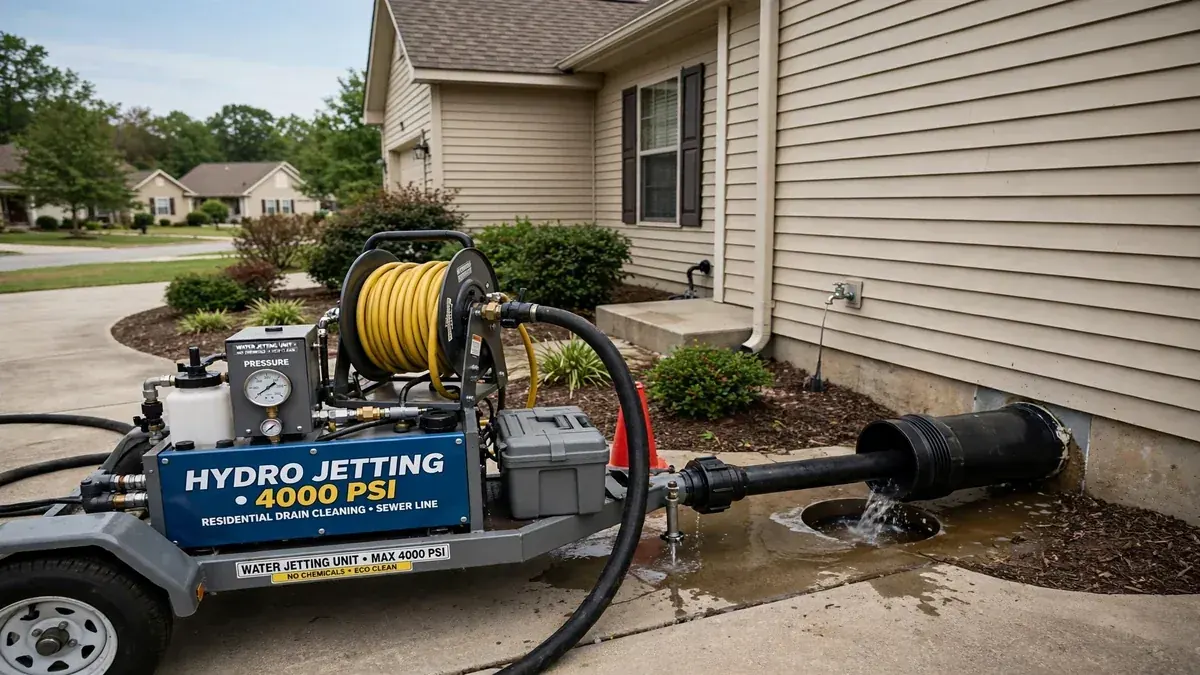
A jet nozzle has several rear-facing ports. The water pushes the hose forward and scrubs the wall as it pulls back, carrying loosened debris down toward the main.
Fine roots are shredded and flushed. Thick, woody roots may need a cutter head on a cable first, then a jetting pass to clean up. Either way, roots can regrow from the opening they entered, so a camera follow-up is part of the plan.
Cable stalled or drain slowing again?
Call the 24/7 line. Tell us how far the last cable went and what the drain does now, and we'll plan a camera look and a clear price.
What to do first when the main line is backing up
Stop every drop of water going down the drain. That means no flushing, no dishwasher, no laundry, and no long showers. Sewage rises at the lowest fixture in the house, usually a basement shower, tub or floor drain.
Keep children and pets away, wear waterproof boots if you must cross wet floors, and wash hands thoroughly afterward. If the backup is active, we can often arrange same-day service when available, even outside normal hours.
Where jetting fits in a Riverton sewer setup
- Private lateral, not the main.Jordan Basin Improvement District (JBID) maintains the sewer main, and the line from your house to the main is yours. We jet the private side, usually from a cleanout.
- Older clay lines grow roots.JBID says clay sewer pipes from before the 1980s are prone to roots. If your house is that old, a jet-and-camera visit every so often can be cheaper than a surprise backup.
- Grease is a district concern too.JBID asks residents not to pour cooking grease down drains, even with a disposal. Jetting removes the buildup, but only changing the habit stops it.
- Beyond the cleanout.If standing water in your cleanout points to a blockage in the main, call JBID at (801) 571-1166 first. We handle the private side.
We also dispatch to Bluffdale and South Jordan, where the same district runs the mains.
Getting ready for a jetting visit
Find your cleanout
It is usually a capped pipe at ground level near the foundation or in the basement. Clear the area around it.
Tell us what you tried
Mention any chemical openers and how far a cable reached. It helps us choose the first tool.
Protect indoor floors
If the access point is inside, we lay protection, but moving boxes and furniture helps a lot.
Expect cleanup
Jetting sends water and debris through the line, so we flush it out, then run the camera again to show the result.
What decides the price of a jetting visit
Pipe length and size
A short branch costs less than a long lateral, and larger bores need more water and time.
How bad the buildup is
Light grease film moves fast. Dense roots or hardened scale take multiple passes.
Access
A good cleanout makes it easy. Installing one adds work.
Camera passes
A look before and after is part of the job, and a longer run takes longer to scan.
Timing of the call
After-hours visits can change the cost, and you hear it first.
Standard homeowners policies often exclude sewer backup, so check your policy, and cleaning for maintenance is typically not covered. Call us for a real number on your line.
Hydro jetting questions we hear
Yes. Our emergency line is open around the clock, and we offer same-day appointments when available. If sewage is backing up, stop all water use and call us.
We run a camera before any high-pressure work, even at night.
It depends on the pipe's condition, not just its age. A camera shows whether the walls are sound, and if they are not, we recommend repair or gentler cleaning first.
A cable opens a channel but leaves the coating on the pipe wall. If the same clog returns within weeks, the pipe probably needs a full scour or a look for roots or damage.
No. It clears roots from the pipe, but roots return through the same gap. A repair or lining job fixes the opening, and scheduled cleaning keeps it manageable until then.
Not usually. The water and debris flow down the pipe and out through the sewer. We protect floors near the access point and flush the line before we leave.
Start with the pattern. A single slow fixture often needs only a cable. A repeat clog, a stalled cable or several slow fixtures usually call for a camera and a jetting plan.
Our sewer camera inspection page explains what the video shows.