Sewage is backing up: what to do first
- Stop all water use.No flushing, laundry, dishwasher or showers. Anything you send down the drain comes back up the lowest opening.
- Keep people and pets out.Raw sewage carries bacteria. Children, pets and anyone with a weakened immune system should stay clear.
- Do not try to wash it away.Hosing a floor drain or running a tub sends more water into a full pipe.
- Turn off power to flooded areas only if you can do it dry.If outlets or appliances are wet, leave them alone and tell us when you call.
- Call the right number.If sewage is coming out of a street manhole, that's the district's line. JBID lists (801) 571-1166 for manholes and piping. For anything life-threatening, call 911.
For a backup inside your home, call our line. We offer same-day service when available, including after hours, and we'll tell you what to expect before we arrive.
Who handles the blockage: the district or you?
Jordan Basin Improvement District
- Maintains the sewer main under the street.
- Serves Riverton, South Jordan, Herriman, Bluffdale and Draper, among others.
- Takes calls about manholes, mains and lift stations at (801) 571-1166.
- Says it is responsible for its main line, not your service line.
You, the property owner
- Own the private line from the house to the main.
- Pay to clear or repair that line.
- Usually pay for backup damage unless the district knew of a system problem and did not fix it in reasonable time.
- Should check homeowners coverage, since standard policies often exclude sewer backup.
JBID, formerly South Valley Sewer District, renamed itself in June 2024. Some city pages still use the old name, but it's the same district.
The cleanout test that tells you where the clog is
Find the cleanout
A capped pipe, often in the yard near the house or in a basement or garage. Clear any items stacked around it.
Open the cap slowly
Stand back and use gloves. If the line is full, water or sewage can push out.
Look inside
Standing water means the blockage likely sits between your house and the main. JBID says to call the district in that case.
No water at the cleanout
That points to a problem inside the house, and we can usually clear it from the cleanout or a fixture.
Don't be tempted to open a cleanout on a backed-up line without a bucket and a plan. Most homeowners are happier letting a plumber handle that step.
What usually blocks a sewer line
Roots
Fine roots enter at joints and cracks, then catch paper and waste. JBID notes that clay pipes from before the 1980s are especially prone.
Grease
JBID says cooking grease does not belong in drains, even with a disposal. It cools and hardens in the lateral.
Flushed items
JBID asks residents not to flush diapers or other disposable hygiene products. They collect in bends and at joints.
A sagging section
A belly in the pipe holds water and solids, so clogs form at the same spot.
Pipe damage
A cracked or collapsed section catches debris no matter how often it's cleared. That's a repair, not a cleaning.
Toilets gurgling or floor drain bubbling?
Call the 24/7 line now. We'll walk you through the cleanout check and plan the fastest safe way to clear the line.
How we clear and confirm a main line
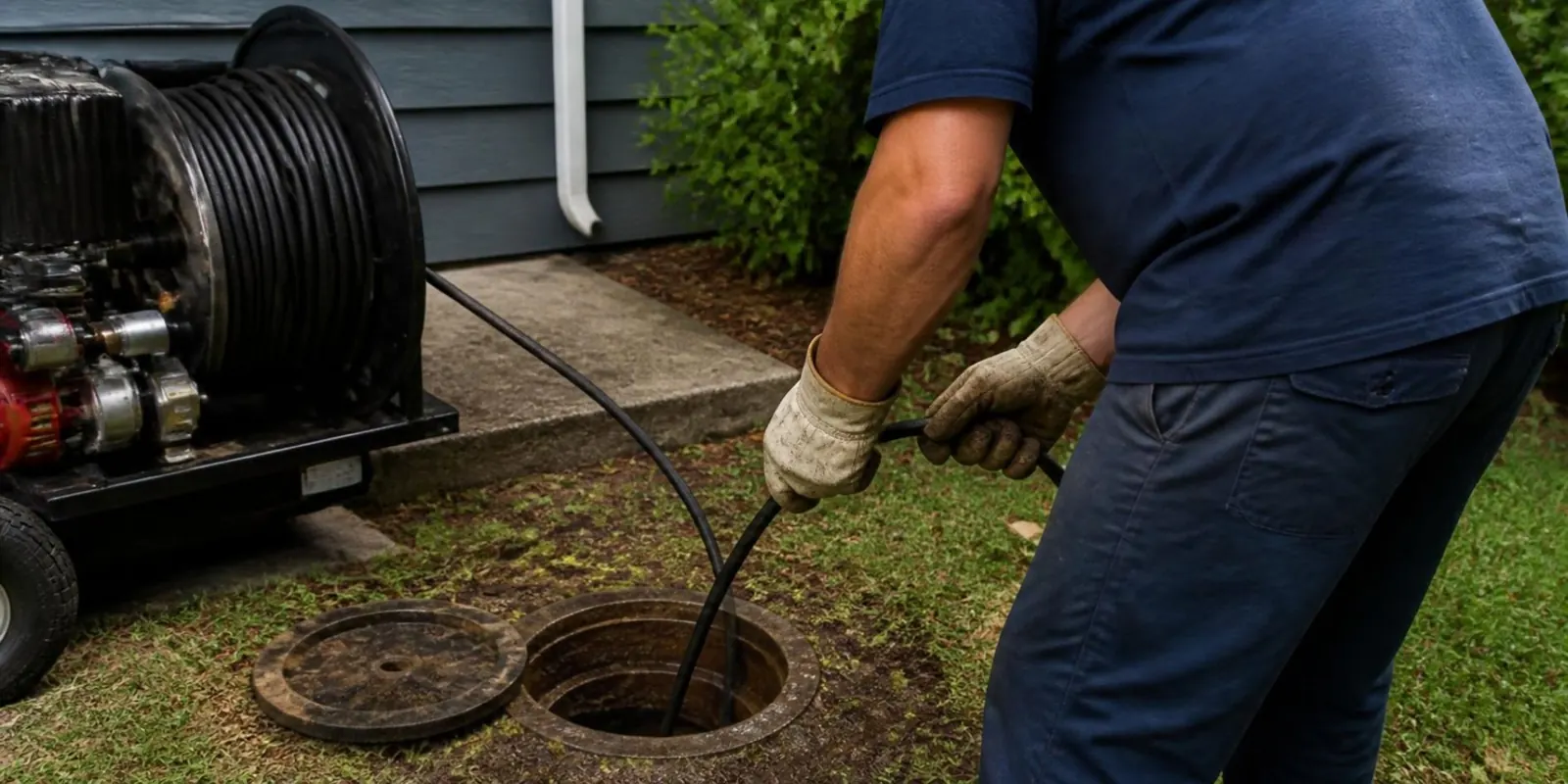
We start with the cleanout when there is one. A heavy-duty cable machine breaks the blockage, and a cutting head deals with roots. If the line is scaled or greasy, hydro jetting follows the cable.
Then we camera the line to confirm the result and look for the reason it clogged. If the video shows a break, a belly or heavy root entry, we'll show you the footage and talk about sewer line repair. We don't guess at a buried problem, we look at it.
Grease traps and storm drains
Grease trap and storm drain cleaning are planned jobs, usually for commercial properties. A restaurant trap needs cleaning on a schedule, and a clogged parking-lot storm drain can flood an entrance after heavy rain.
Call with the type of property and what is installed. We'll tell you honestly whether we can do the work or whether it needs a specialty hauler, and our commercial plumbing page covers the rest.
What affects the price of a sewer line cleaning
Access point
A cleanout lets us work cleanly. Without one, we may pull a toilet or work from a roof vent.
Length of the lateral
A longer run takes more cable, more time and more camera footage.
What is in the pipe
Paper and soft debris clear fast. Packed roots or hard grease take heavier tools.
Jetting after cabling
A cleaner pipe wall lasts longer, and it adds equipment and time.
After-hours timing
A middle-of-the-night visit can cost more, and you'll hear the number first.
Standard homeowners policies often exclude sewer backup, so check your policy and ask about any added coverage. Call us for a real number on your line.
Sewer backup and cleaning questions
Yes. Our emergency line runs around the clock, and same-day appointments are offered when available. Call, say that sewage is backing up, and follow the steps to stop water use.
The district maintains the main, and you own the private line to it. JBID says the homeowner pays for backup damage unless the district knew of a system problem and failed to fix it in reasonable time.
The cleanout test is the quick way to see which side the blockage is on.
The basement shower or floor drain is usually the lowest opening in the house. When the main line is blocked, sewage rises there first.
A plunger does little against a main line blockage, and chemicals just sit in the pipe and can injure whoever opens it. Stop using water and call us.
Those are planned, mostly commercial jobs. Call with the property type and equipment, and we'll be upfront about whether it's work we do or one for a specialty hauler.
It shows whether the pipe is clean, whether roots or a belly are the real cause, and whether a repair is needed. See our sewer camera inspection page for details.