
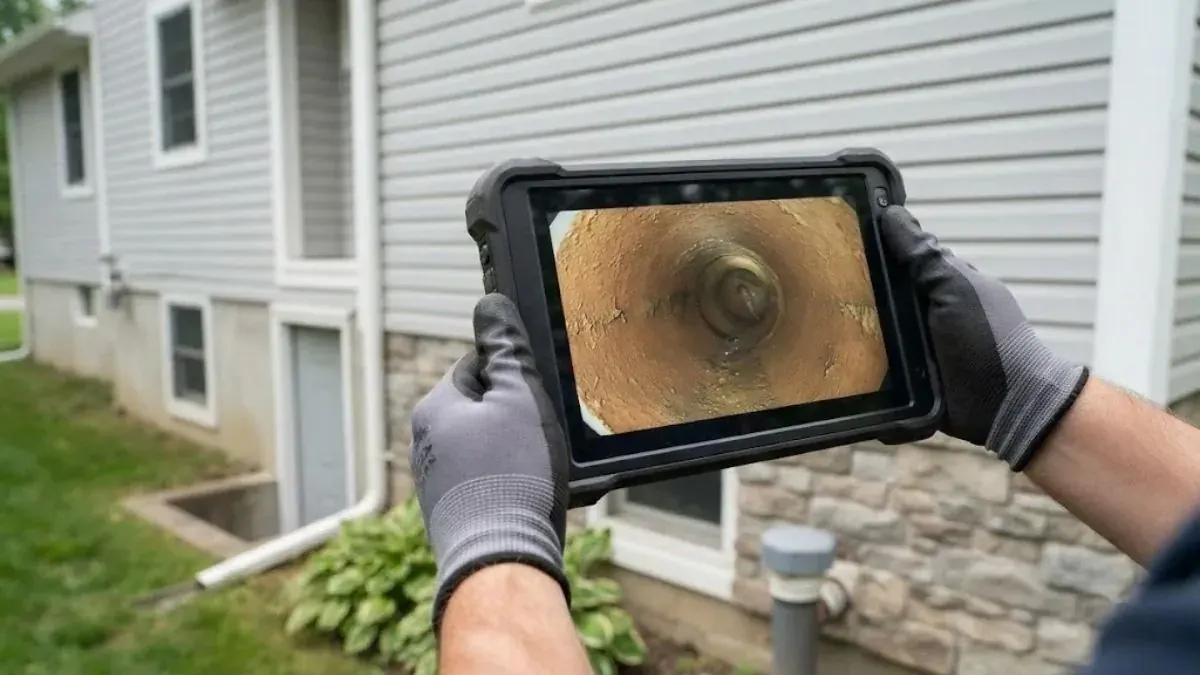
What the camera video actually shows
A pipe that looks fine from the outside can be failing inside. The camera head has lights and a sealed lens, and it records as it is pushed down the line, so every joint and bend is on video.
| On the screen | What it usually is | What it means for you |
|---|---|---|
| Hair-thin white threads or a dense mat | Roots entering at a joint or crack | Needs cutting or jetting now and a repair plan if the opening is large |
| A pool of water that doesn't drain | A belly or sag in the pipe | Solids settle there and cause repeat clogs, so monitor or fix |
| A ring or line across the pipe wall | Offset joint or a crack | Debris catches, roots enter, and it can widen over time |
| Rough, flaking pipe wall | Corrosion or scale in older metal pipe | Narrowing bore, so ask about lining or replacement |
| Smooth, clear flow end to end | A sound pipe | A recurring clog is probably the habit, not the pipe |
How an inspection visit works
Find the access
Usually a cleanout. If there isn't one, we may pull a toilet or work from a roof vent, and we'll say so first.
Clear what blocks the view
A full pipe can't be filmed. We may need a light cable pass or jetting before the lens can see.
Push the camera downstream
We note the distance to each defect as the footage records.
Locate and mark
A locator finds the camera's transmitter from above, so we can paint a mark on the ground and read the depth.
Review it with you
We show the screen, point out each finding and tell you what we'd do about it, including doing nothing.
A camera check before you buy
Standard home inspections often do not send a camera down the sewer lateral. If you buy the house, you own the private line from the home to the main, along with whatever is wrong with it.
Ask the seller for access to the cleanout and schedule the camera before your inspection period ends. If it finds roots or a broken section, you can negotiate a repair or a credit before closing.
- A clear video won't prove the line stays clear. It shows its condition on that day.
- Roots in an old clay lateral are common, and a root-cleaned pipe can still be sound.
- A broken or collapsed section is the finding that changes the price you offer.
Want to see inside your sewer line?
Call and tell us what the drains are doing or when your inspection period ends. We'll plan the visit and give you a clear price.
Finding where the pipe runs and where it fails
Locating is a separate skill from filming. A transmitter in the camera head sends a signal, and a handheld receiver above ground picks it up. That gives the line's path and the depth to the defect.
This matters before any dig. We don't guess where a buried problem is, we locate it, then call 811 through Blue Stakes of Utah so other utilities are marked before anyone breaks ground.
What happens after the video
- Clean pipe, no defects.You keep the footage as a baseline. Repeat clogs then point to habits, like grease or flushed items.
- Roots or scale only.Hydro jetting cleans the wall and gives you a better view on a re-run.
- A break, offset or heavy sag.That's a job for sewer line repair, with options laid out for your pipe.
- A blockage in progress.Sewer line cleaning comes first, and the camera confirms the result.
What a Riverton inspection covers and what it doesn't
Jordan Basin Improvement District (JBID) maintains the sewer main, and you own the private line to it. Our camera covers your line, and if the footage suggests a main problem, we'll tell you and point you to the district at (801) 571-1166.
JBID notes that clay pipes from before the 1980s are prone to roots. We also inspect lines for homeowners in South Jordan and Bluffdale, where the same district serves the mains.
What affects the price of a camera inspection
Access
A cleanout is simple. Pulling a toilet or working from a roof vent takes longer.
Length and route
A longer lateral with more bends takes longer to film and review.
Cleaning first
A pipe full of debris or roots must be opened before the camera can see.
Locating and marking
Surface marks and depth readings add time, and they help any later repair.
Documentation
Video you can share with a buyer, seller, insurer or contractor takes a few minutes to put together.
Insurance usually will not pay for an inspection on its own, and standard policies often exclude sewer backup, so check yours. Call us for a real number on your line.
Sewer camera inspection questions
Yes. We review the footage with you on site and provide a copy along with a plain summary of what we saw and where.
It can show cracks, broken joints and water entering a pipe, but it can't always see soil washing around the outside. We combine it with locating and, when needed, a water test.
A clear video usually points to what goes down the drain. Grease, hygiene products and food scraps build up in a good pipe too. JBID asks residents not to pour grease down drains or flush diapers and similar products.
In most cases, yes. A typical home inspection often skips the buried lateral, and the buyer owns it. Ask the seller for access to the cleanout before your inspection period ends.
A push camera is gentle on sound pipe. If the pipe is cracked or collapsing, we stop and tell you rather than force it through.
We can usually reach the line through a toilet flange or a roof vent. We'll tell you the access plan before work starts, and a cleanout can be added later if you want one.