
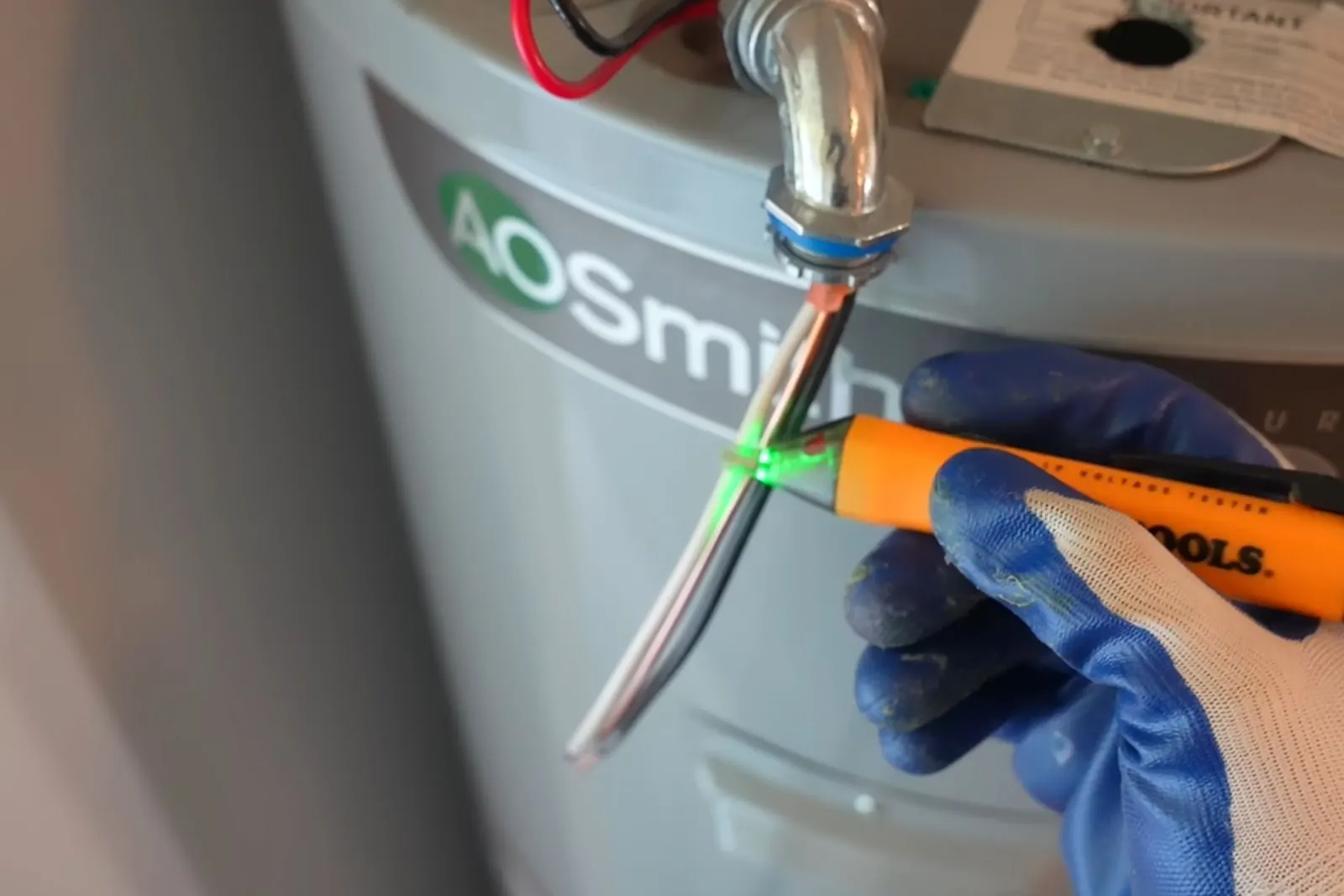
When a leaking water heater is an emergency
A slow drip is a repair problem. A heater pouring water, or sitting on finished flooring, is an emergency, because a full tank holds a lot of water and a failing seam can empty it fast. Do these things in order while you wait.
Smell for gas first
A rotten-egg smell means leave the building and call Enbridge Gas Utah at 1-800-767-1689 or 911 from outside. Do not flip switches. Call us after the gas utility says it is safe.
Shut the cold supply
Turn the valve on the cold pipe above the heater clockwise until it stops. This ends the refill.
Cut the fuel
Switch off the breaker on an electric heater, or turn a gas control knob to off. Never power an element in an empty tank.
Protect the area
Move electronics off the floor, set a bucket under any drip, and keep children and pets clear. Stay back from hot spray.
Read the puddle: where the water comes from decides the fix
Dry the floor, watch for a few minutes, and note where fresh drops form. That location tells us most of what we need before we open a toolbox.
| Where the water shows up | Likely cause | Repair or replace |
|---|---|---|
| Pipe connections on top | Loose or corroded supply fittings, worn connectors | Usually repair |
| Pipe from the relief valve | Valve opening on high pressure or temperature, or a worn seat | Often repair after a pressure test |
| Drain valve near the bottom | Worn valve seat or debris stuck in it | Usually repair |
| Electric element panel | Failed element gasket or loose element | Often repair |
| Seam or base of the tank | Corrosion has breached the steel shell | Replace, since a shell cannot be patched |
Condensation can fool you. A cold tank in a humid room can bead and drip with nothing wrong, so we dry every surface and see where moisture returns.
No hot water, lukewarm water, or a tank that runs out fast
Losing hot water rarely means the whole heater is finished. The symptom narrows the list of parts quickly.
Completely cold
Electric: tripped breaker, failed thermostat or burned-out element. Gas: pilot out or a flame sensor that no longer reads the flame.
Warm but never hot
One of two elements has failed, the thermostat is set low, or a gas burner is dirty.
Hot for a few minutes only
Sediment is eating tank volume, or a broken dip tube sends cold water straight to the outlet.
Rumbling or rusty water
Scale traps steam bubbles at the tank bottom, and rust-colored hot water points to the tank interior or a spent anode rod.
Gas, electric, and hybrid heaters fail in different ways
Gas units depend on a flame, a gas control valve, a flue and a flame sensor. We check venting and draft before calling the job done, and gas connections are licensed work, not DIY.
Electric units use two elements and two thermostats. We test each with a multimeter, and you should stay out of the access panel because the wiring is live.
Hybrid (heat pump) heaters add a compressor and fan above the tank. We diagnose the plumbing and electrical side and tell you early if a fault points to sealed refrigerant work, which falls outside plumbing.
Water heater down? Call the 24/7 line
Tell us the fuel type, where the water is and whether you smell gas. We state the price before we start work.
How the fault gets found before any part is replaced
- Moisture meter along seams and fittingsto find the true origin of the water.
- Pressure gauge on a hose bibto see whether supply pressure is pushing the relief valve open.
- Multimeter on elements and thermostatsto test continuity and voltage.
- Gas detector and soap solutionon gas connections, plus a flue draft check.
We do not guess. If the tank shell has failed, we show you and explain why a repair would not hold.
Repair or replace: a quick way to decide
Repair makes sense when
- Water comes from a fitting, valve, relief pipe or element gasket and the tank underneath is dry.
- Testing finds a bad thermostat, element or pilot assembly.
- The heater has had few problems so far.
Replace makes sense when
- Water seeps from the tank seam or base.
- Failures repeat and each fix buys only a few months.
- The next repair costs about what a new installation would.
Manufacturers and plumbers commonly say many tank heaters reach their last years around a decade, but a well-kept unit may run longer. We decide from what the diagnosis shows, not from age alone.
Local conditions that affect heaters here
Hard water and sediment
Riverton's 2022 water quality report lists average hardness of about 190 mg/L (roughly 11 grains per gallon). Scale builds faster in harder water, so ask about a yearly flush or a water softener.
Earthquake strapping
Utah's amendment (Utah Code 15A-3-305) calls for tank heaters to be strapped in the upper and lower third of their height. If yours has loose or missing straps, tell us during the visit.
City water, owner pipes
Riverton owns the line up to and including the meter. From the meter to your home is yours, so a pressure problem at the heater is checked on your side first.
Permit questions
Riverton requires a building permit for work on plumbing systems the code regulates. Ask the Riverton building department whether your repair needs one.
What a heater repair costs depends on these things
Which part failed
A relief valve or thermostat is a smaller job than a gas control valve or burner assembly.
Fuel type and venting
Gas work adds combustion and venting checks.
Access and location
A tight closet, attic or stairway slows the work.
Water damage on site
Standing water means stopping the source first.
After-hours calls
A late-night visit costs more than a daytime one, and we say so before work begins.
Homeowners policies often cover sudden water damage from a failed heater but usually not slow leaks or wear, so photograph everything before cleanup. Call the 24/7 line for a real number on your heater.
Rules and sources behind this page
Repairs touching the heater's gas, vent or relief components are held to the plumbing code Utah adopts, and the Utah amendments cover strapping and drain pans. Utah Code 15A-2-103 adopts the 2024 International Plumbing Code (IPC) as the state plumbing code, effective July 1, 2026, with Utah amendments on top.
According to Enbridge Gas Utah, a gas smell means you leave the area immediately and call 1-800-767-1689 or 911 from a safe place. That standard comes before any heater diagnosis.
Water heater repair questions we hear in Riverton
Yes. Our line runs 24/7, and we send a licensed plumber for same-day appointments when available, including nights and weekends. Shut the cold supply valve above the tank first if you can reach it safely.
It depends on the source. A drain valve or loose connection can be repaired. Water seeping from the base or seam means the shell has corroded through, and that is a replacement.
On an electric unit the usual culprits are the upper thermostat, a tripped high-limit switch or a burned-out element. On gas, look at the pilot and flame sensor. We test each part before replacing it.
Leave the building, then call Enbridge Gas Utah at 1-800-767-1689 or 911 from outside. Do not use switches, lighters or a phone indoors. Call us once the gas utility clears the home.
For many heaters, yes. Draining sediment helps with rumbling and lost capacity. If the drain valve is old, it can fail when opened, so have a plumber do it on a heater that has never been flushed.
Yes to both. See our tankless water heater page for those units. We also dispatch to South Jordan and Herriman from our Riverton base.