
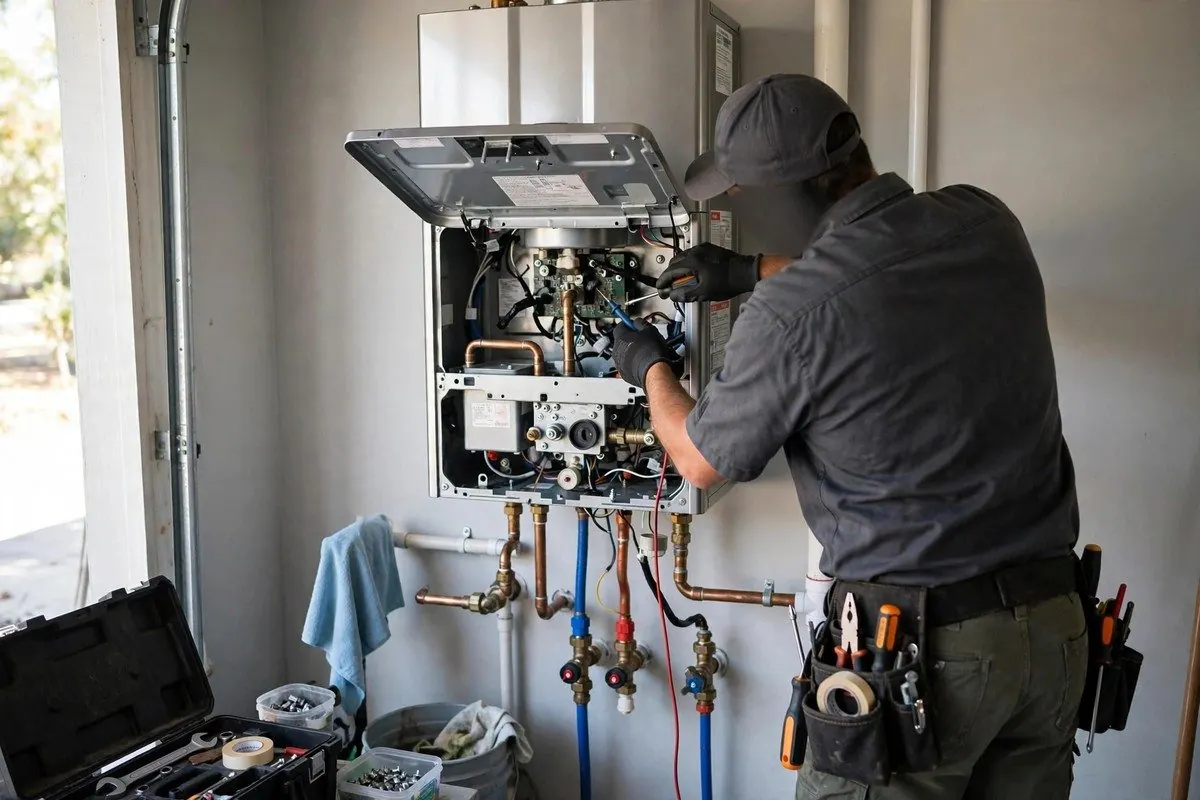
Does a tankless heater suit your house?
Tankless tends to suit you if
- You want hot water without waiting for a tank to recover between showers.
- You have wall space and a safe way to vent a gas unit.
- Your gas line can carry the load, or you are willing to upgrade it.
- You plan to stay long enough to appreciate the savings and maintain the unit.
A tank may suit you better if
- Your gas line or venting would need major changes.
- You want the lowest upfront cost and the simplest swap.
- You do not want a yearly flush on your schedule.
- Several fixtures run at once and the unit would be undersized.
We size the unit by how many fixtures run together and the temperature rise your incoming water needs. We do not size it by guesswork or by house size alone. If you are replacing a failed tank, our replacement page explains the tank route.
Gas line, venting and power come before the heater
A tankless gas unit burns a lot of gas in a short burst. A pipe that served a tank heater fine can starve a tankless unit, and the symptom is a heater that shuts down or runs cold under load.
- Gas supply.We measure the existing line run and fittings against the unit's input rating, and upgrade where it falls short.
- Venting.These units need their own approved vent materials and a clear route to the outdoors. Tank flues cannot simply be reused.
- Electric and condensate.Most units need a power outlet, and condensing models need a drain for acidic condensate.
- Water pipe sizing.Undersized hot water lines cut flow, so we check pipe size and shutoffs, including isolation valves for later flushing.
Gas connections and venting are licensed work. If you ever smell gas, leave and call Enbridge Gas Utah at 1-800-767-1689 or 911 before calling us.
Flushing and descaling a tankless heater
Riverton's 2022 water quality report lists average hardness of about 190 mg/L, roughly 11 grains per gallon. Scale builds faster in harder water, and a tankless heat exchanger has very narrow passages that scale can narrow further.
Signs it is time for service include an error code, lukewarm water that used to run hot, a falling flow rate, or noises from the unit. Many callers simply notice the heater has gone years without attention.
Isolate the unit
Close the water and gas, and open the service valves.
Circulate descaler
A pump pushes a mild acid solution through the heat exchanger for a set period.
Rinse
We flush with clean water until it runs clear, then remove the filter screen.
Clean the inlet screen
Debris on the screen lowers flow, so we clean it every visit.
Test and record
We restore gas and water, run hot water, and check for error codes.
If your tap tests hard, a water softener ahead of the heater reduces scale at the source.
What to do if a tankless unit acts up
- Smell gas? Leave first.Walk out and call Enbridge Gas Utah at 1-800-767-1689 or 911 from outside. Do not use switches or phones in the building.
- Turn off power at the unit.Electric and gas units both have controls. Switch them off before checking anything near the vent or the water connections.
- Do not touch hot vent pipes.Exhaust pipes run hot. Keep children and pets away from them.
- Close the cold supply for a leak.Water on the floor under the unit means shut the cold inlet and call.
Questions about your tankless heater?
Call and tell us the model type, its age and the symptom. We tell you whether it needs a flush, a repair or a different plan, and we state the price first.
Repair, flush or replace: what each symptom suggests
| Symptom | Common cause | Usual next step |
|---|---|---|
| Water turns lukewarm or fluctuates | Scale in the heat exchanger or clogged inlet screen | Flush and descale |
| Error code and shutdown | Vent, gas supply or flame sensing fault | Diagnose, then repair |
| No hot water at low flow | Flow too small for the unit to fire, or a sensor fault | Test flow, check sensors |
| Leak at the unit | Failed fitting or a cracked heat exchanger | Repair a fitting, replace a failed exchanger |
| Heater never meets demand | Unit undersized for fixtures running together | Resize or add a second unit |
What helps us prepare for a tankless job
Photograph the data plate
The model and serial label tells us input rating, fuel and venting type.
Note the symptom
Error code, how long it has acted up, and whether it runs at low or high flow.
Know where the gas meter and line are
It helps us size the gas supply.
Clear the area
Leave a working space around the unit and any shutoffs.
For Draper or Bluffdale homes we dispatch from Riverton, so the same preparation applies.
What shapes the price of a tankless job
Unit capacity and type
Flow rating, gas or electric, and condensing or non-condensing models vary.
Gas line upgrade
A bigger gas line costs more than reusing the old one.
Venting route
Longer runs and wall or roof penetrations add materials and labor.
Water quality and flush plan
Isolation valves for flushing and any softener you add change the total.
Service scope
A flush and descale is a different job from a repair.
A tankless installation is a planned upgrade, so insurance usually does not cover it. Call us for a real number once we know your unit and your gas line.
Rules and sources behind this page
Tankless installs follow the plumbing code Utah adopts, with gas and venting requirements from the manufacturer's instructions. Utah Code 15A-2-103 adopts the 2024 International Plumbing Code (IPC) as the state plumbing code, effective July 1, 2026, with Utah amendments on top.
Riverton's 2022 water quality report lists average hardness of about 190 mg/L, roughly 11 grains per gallon. According to manufacturers' general guidance, scale builds faster in harder water, which is why the flush section above matters.
Tankless water heater questions in Riverton
Many manufacturers call for a flush about once a year, and sooner in hard water. Riverton's 2022 report lists hardness around 11 grains per gallon, so a yearly flush is a sensible starting point.
Yes. Send us the model and the symptom. We flush, descale and repair what is repairable, and we tell you when a part or a unit is past saving. Tank units are covered under water heater repair.
Not always. These units draw a lot of gas at once, so we measure the pipe run and compare it to the unit's rating. If it falls short, we quote the upgrade separately.
Manufacturers commonly say longer than a tank heater when maintained, but we do not promise a number. Flushing and good venting matter more than age.
It does not run out, but it can reach its flow limit. If several fixtures run together, the water may turn lukewarm. Sizing the unit properly is the fix.
It depends on the house. Savings and space matter, but so do gas line work, venting and yearly service. We walk you through both on a call.