
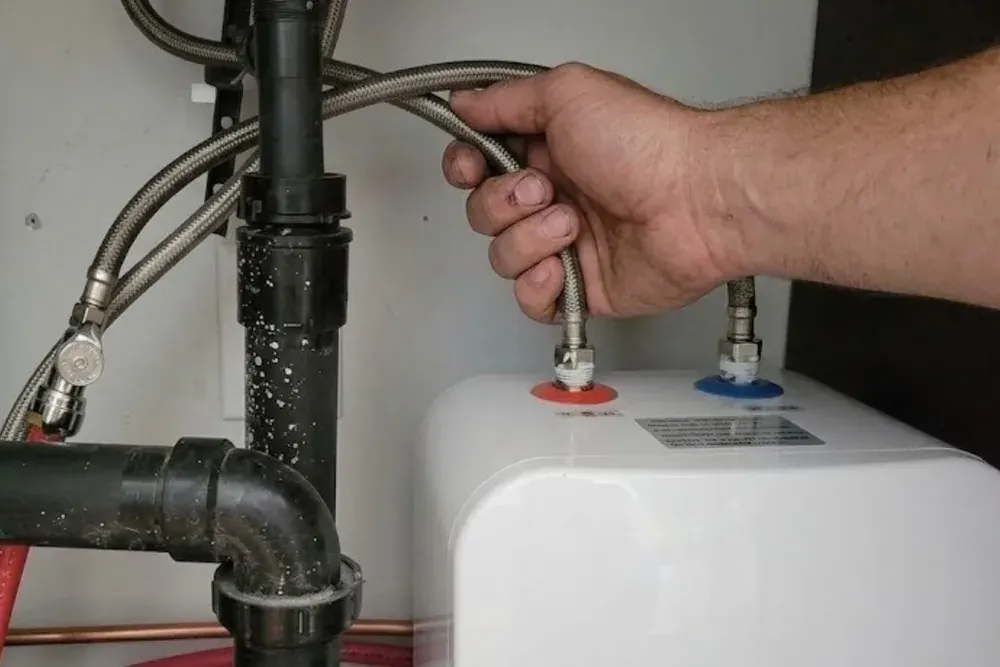
The cold inlet, the hot outlet and the connectors between them
Two pipes enter the top of most tank heaters. One brings cold water in, and one carries hot water out. Between the house piping and the tank sit short connectors. Some are rigid copper, some are corrugated stainless flex, and some are plastic-lined flexible lines.
A connector can fail at the crimp, at the nut, or along its length. Look for white or green crust at a joint, a damp spot that returns after you wipe it, or a connector that looks kinked. Mineral crust usually points to a slow weep that has been going for a while.
Dielectric fittings sit where two different metals meet, such as copper pipe meeting a steel tank. Their job is to slow corrosion at that joint. When a dielectric union or nipple is crusty, soft, or visibly eaten away, it is time to replace it, and the connectors on either side are usually replaced with it.
The valve that must close when you need it
Every water heater should have a cold-side shutoff valve within reach. Try it once a year. If the handle will not turn, it turns but water still flows, or it drips from the stem, the valve is no longer doing its job and should be replaced.
Old gate valves are the usual troublemakers. They seize from mineral buildup and break when forced. A ball valve with a quarter-turn handle is easier to trust and easier to see at a glance. Swapping a valve means shutting off water to the house, so it is a short plumbing job with a real risk of a stuck main shutoff.
If the main shutoff at the house will not close either, stop there. Fixing a failed main takes a plumber, and our water heater repair crew often replaces the heater shutoff in the same visit.
The relief valve and its discharge pipe
The temperature and pressure relief valve opens if the tank gets dangerously hot or the pressure climbs too high. A discharge pipe runs from it, usually down the side of the tank, to carry that water to a safe spot. That pipe should not be capped, plugged or reduced in size.
If the discharge pipe is dripping steadily, do not plug it. A dripping relief valve is the heater telling you something: the valve is worn, the water pressure is running high, or thermal expansion in a closed system has nowhere to go. A plumber tests the valve and checks the pressure at a hose bib with a gauge.
Replacing the valve and the discharge line is a plumber's job. Pipe material and route matter, and a wrong repair can hide the problem rather than fix it. Never test the valve by lifting the lever unless you can catch the hot water safely.
Spotted crust or a drip at your heater?
Call the 24/7 line. A licensed plumber can look at the connectors, valves and discharge line and tell you what is worth replacing.
What Riverton homeowners should know
Riverton's 2022 water quality report lists average hardness of about 190 mg/L, roughly 11 grains per gallon. Hard water leaves mineral scale, and scale can crust fittings and seize old valves. It may contribute to corrosion at joints too, but a plumber has to see the actual fitting to know. Test your tap and ask the Riverton water division for its latest annual report.
Utah's statewide amendments also affect what sits around a heater. A pan under the heater may receive discharge from the heater only, and a pan drain may connect to a soil or waste stack only when the code official permits, individually trapped and vented. Heaters must be anchored or strapped against earthquake motion. Ask the Riverton building department what your job needs.
Sources: Riverton City 2022 water quality report, Utah Code 15A-3-305
The gas flex line and why it is not for DIY
A gas water heater connects to the house gas line through a flexible connector and a shutoff valve. Flexible connectors age, and a kinked or corroded one is a safety hazard. Connecting or replacing one requires a licensed plumber and a leak check afterward.
If you smell gas near the heater, do not search for the source. Leave the building and call Enbridge Gas Utah at 1-800-767-1689 or 911 from a safe place. Do not use switches or phones inside. Call a plumber after the gas utility clears the building.
What a homeowner can check and what needs a plumber
Reasonable to check yourself
- Look for crust, rust or damp spots at each connector
- Operate the cold shutoff to see if it turns
- Check the area under the discharge pipe for drips
- Note whether the base of the tank is dry
- Write down what you see, with photos
Leave to a licensed plumber
- Replacing gas flex lines or gas valves
- Replacing the relief valve or its discharge pipe
- Soldering or replacing copper at the heater
- Swapping a main shutoff or a seized isolation valve
- Any connector leak you cannot shut the water off to
When trouble at the heater points to the rest of your piping
Sometimes the connector is not the problem. If you replace a fitting and the next one downstream starts weeping, or you find pinhole leaks along pipe near the heater, the piping itself may be wearing out. Rust-colored water, falling pressure and repeated small leaks across the house tell the same story.
That is the point to ask about a wider fix. Our repiping service explains how a plumber inspects, what pipe materials are options, and when spot repairs stop making sense. A good plumber will tell you when connectors are enough and when they are a bandage.
| What you see | Probably means | Next step |
|---|---|---|
| One crusty connector, other pipe looks fine | Single worn fitting | Replace the connector and nearby valve |
| Several joints weeping in a row | Fittings aging together | Replace the set, ask about pipe condition |
| Pinholes in copper near the heater | Corrosion in the pipe itself | Plumber inspection, consider repiping |
| Hot water rusty, cold clear | Tank or heater piping corroding | Check tank interior and connections |
| Dripping relief discharge | Valve wear or pressure issue | Plumber tests valve and pressure |
If you live just south or west of Riverton
We are based in Riverton, and we also dispatch to Bluffdale to the south and Herriman to the west. Water chemistry differs across those towns, and Herriman has said its supply mix changes with the season, so connector wear can differ from house to house. Inspection beats assumption.
Rules and sources behind this page
Connection work at the heater follows the IPC as Utah amends it. Utah Code 15A-2-103 adopts the 2024 International Plumbing Code (IPC) as the state plumbing code, effective July 1, 2026, with Utah amendments on top. Utah's amendment also requires strapping against earthquake motion and limits what a pan drain may connect to.
For a gas smell near the heater, the safety standard is to leave and call Enbridge Gas Utah at 1-800-767-1689 or 911 first.
Heater piping questions
First work out which pipe it is. A drip from the relief discharge means a worn valve or high pressure. A drip from a connector means a leaking joint. Shut off the water to the heater if it grows.
Look for crust, rust, kinks or damp spots. Connectors that are bulging, leaking at the crimp, or visibly corroded should be replaced. A plumber can swap them in one visit and check the nearby valve.
It is possible with the right tools, but it means shutting off house water and cutting or unthreading pipe. If your main shutoff will not close, stop and call a plumber. A failed main turns a small job into a flood.
It can be a sign of a real pressure or temperature problem. Do not cap or plug the discharge pipe. Call a plumber to test the valve and check house pressure with a gauge.
No. Gas connections need a licensed plumber and a leak check. If you smell gas, leave and call Enbridge Gas Utah at 1-800-767-1689 or 911 first.
Riverton's 2022 report lists hard water, and mineral scale commonly builds on fittings and valves. Whether it caused a specific failure is for a plumber to judge on site. Testing your tap shows what your water is doing.
Repeated leaks, pinholes, falling pressure and discolored water across the house suggest piping wear. We inspect before recommending anything, and sometimes the answer is simply new connectors.