
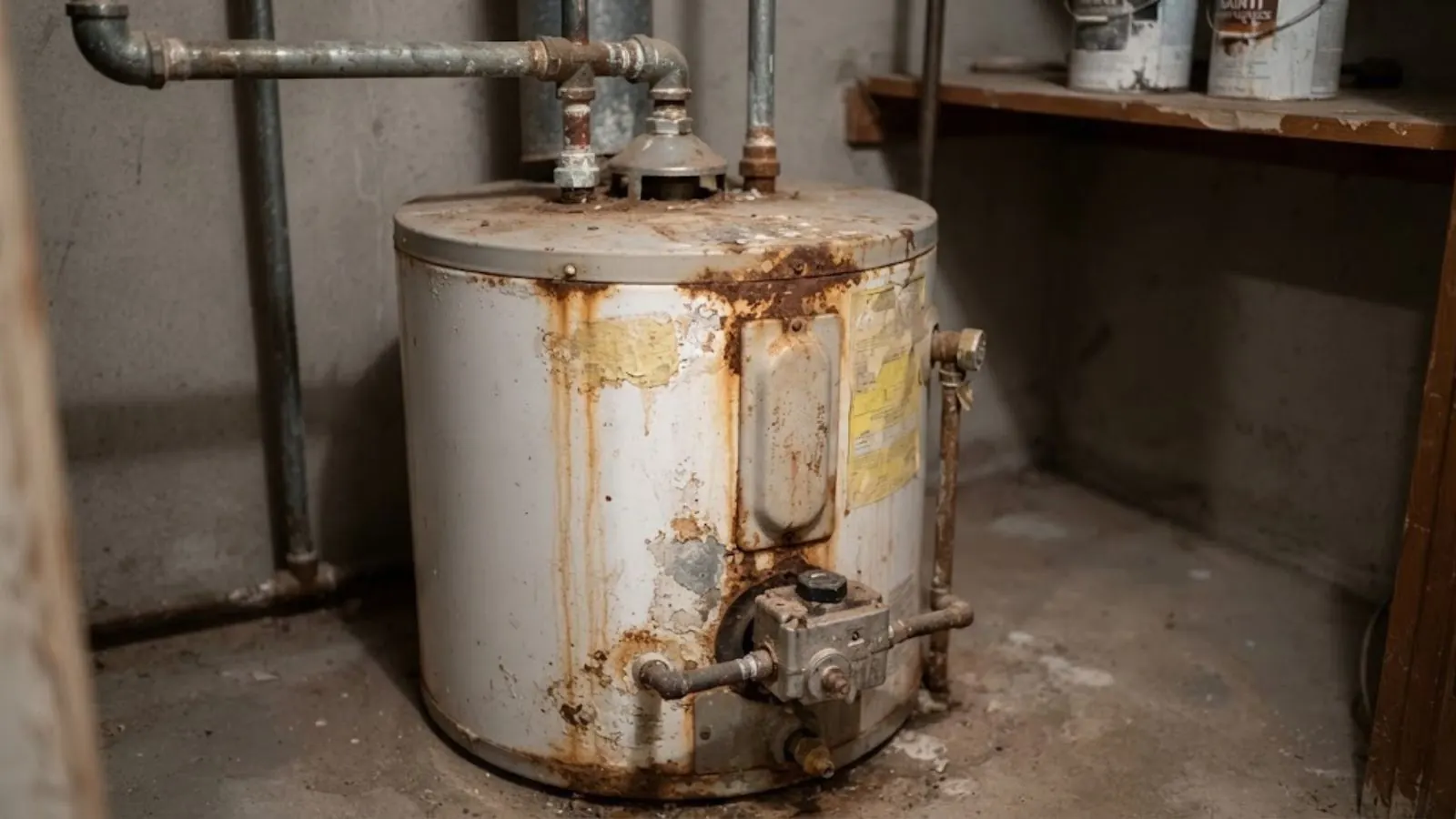
Find where the water is coming from
Before anything else, work out whether the water on the floor is coming from the tank or from something attached to it. Dry the base with a towel, then watch it with a flashlight. Water running out from under the jacket, or beading on the bottom of the tank, points to the tank. Drips from the pipe on top, the valve on the side, or the drain at the bottom point to a part.
A tank leak means the steel shell has corroded through. It does not stop and it is not repairable. If you see one, shut off the cold supply to the heater, turn the gas control to off or switch off the breaker, and call us. Gas smell is a different case: leave the building and call Enbridge Gas Utah at 1-800-767-1689 or 911 first.
Symptoms and what they usually mean
| What you notice | Likely cause | Usually |
|---|---|---|
| Water pooling under the tank, jacket wet | Corroded tank shell | Replace |
| Drip from the relief valve or its pipe | Pressure or valve fault | Repair, then investigate pressure |
| Lukewarm water, never hot | Failed element or thermostat, or a burner problem | Repair |
| No hot water at all | Tripped breaker, pilot or ignition fault, or failed element | Repair first |
| Rust-colored hot water only | Anode spent or tank rusting inside | Replace is likely |
| Rumbling or popping from the tank | Sediment baked on the bottom | Flush or replace, depending on severity |
| Same repair twice in a short time | Tank wearing out generally | Replace |
Where age fits in
Manufacturers and plumbers commonly say that many tank heaters are in their last years around a decade, and that the later years are when failures bunch up. Treat that as a rough reminder, not a rule. A well-maintained tank can run longer, and a neglected one can quit sooner.
The data plate on the tank carries the serial number, and the maker's manual or support line can decode the build date from it. If that is unclear, call us and we will help you read it. An older heater with a spotless base and steady hot water is in a different position from the same heater with rust at the drain valve.
If a heater is old and has just failed in a way that needs a repair costing a fair share of a new unit, replacement usually makes better sense. If it is old and merely a little slow to heat, ask for a diagnosis before you spend on a new one.
Not sure which side your heater is on?
Call the 24/7 line. A licensed plumber can look at the tank, valves and base, then tell you plainly what is worth fixing.
What Riverton homeowners should know
Utah's statewide plumbing amendments require water heaters to be anchored or strapped against horizontal movement from earthquake motion, with straps in the upper one-third and lower one-third of the heater's height. If your old heater was never strapped, a replacement is the time to fix it. Check any heater you plan to keep, too.
Riverton says a building permit is required for work on plumbing systems regulated by the code, and applications go by email to the city's building inspections office. The city page does not say whether a like-for-like heater swap needs one, so ask the Riverton building department before work starts. Utah Code 15A-2-103 adopts the 2024 International Plumbing Code effective 7/1/2026, and your plumber should be working to the current code.
Sources: Utah Code 15A-3-305, Utah Code 15A-2-103, Riverton Building Inspections and Permits page
Six problems that look scary but are often repairable
No heat on an electric unit
A burned-out upper or lower element, or a thermostat that has stopped switching, is a common reason. Both are replaceable parts.
Pilot will not stay lit
A weak thermocouple or a draft at the burner can be the cause. A plumber tests it before you decide the heater is finished.
Relief valve drips
A weeping valve may simply be worn. It may also be reacting to a pressure or expansion problem in the house, which the plumber should check.
Fitting leaks on top
A loose or corroded connector at the inlet or outlet can be reconnected or replaced. See our water heater repair work for how we sort these.
Drain valve drips
A cheap valve can be replaced, though it should be done with care because old drain valves can break when disturbed.
Thermostat set wrong
Sometimes the answer is a dial. A plumber can check for a scalding or lukewarm setting before any part is swapped.
When waiting costs more than fixing
- Water on the floor that returns after you dry it.If the tank is the source, the leak will grow. Water damage to flooring and drywall costs more than the heater.
- A metallic smell or rust in hot water only.Cold water that runs clear while hot water rusts suggests the inside of the tank, not the pipes.
- Rumbling that has gotten louder.Sediment hardens on the bottom over time. A flush may help when caught early, and a heavily scaled tank may be past saving.
- A scorched or sooty look around the burner or flue.This is a safety issue on gas heaters. Shut the heater off and call a plumber.
Our water heater replacement team can explain the replacement path, including tank, tankless and heat pump options, once you know that is where your heater stands.
What a replacement usually involves
Shut off and drain the old tank
The plumber closes the water supply, turns off the gas or power, and drains the tank to a safe spot.
Disconnect and remove it
Water lines, gas connector or electrical feed, vent and relief discharge line come off. The old heater is hauled away.
Set the new heater and its pan
The new tank goes in with a drain pan if the location calls for one, and the relief valve and discharge line get connected.
Strap it
Utah requires water heaters to be anchored or strapped against earthquake motion. A plumber installs the straps.
Fill, vent, test
The tank is filled first, then the gas or power comes on. Fittings are checked for leaks and the burner or elements are tested.
Timing depends on the location, the vent and any code upgrades the old install needs. We do not promise a clock time. Hot water returns once the new tank has heated.
If you live just north or east of us
Riverton is our home base, and we also dispatch to South Jordan, just north, where the city's own FAQ says a permit is needed for a new water heater. Many homeowners east of us in Draper ask the same question, and Draper's building office is the place to confirm what your job needs. In both cases the safest habit is to call the local building office before swapping a heater.
Rules and sources behind this page
Replacement follows the plumbing code Utah adopts, including the amendment requiring strapping in the upper and lower thirds of the heater's height. Utah Code 15A-2-103 adopts the 2024 International Plumbing Code (IPC) as the state plumbing code, effective July 1, 2026, with Utah amendments on top.
Riverton's building office says a permit is required for work on plumbing systems the code regulates. Ask whether a like-for-like swap needs one, because the city's page does not say.
Water heater replacement questions
Dry the base and watch where new water appears. Water from under the tank jacket or the bottom edge usually means the shell has failed. Water from a pipe, valve or fitting is a part problem. When in doubt, shut the water to the heater and have it checked.
If the heater is old, has rust in the water, or has started rumbling loudly, planning ahead is cheaper than an emergency replacement. A failed tank can flood a utility room. A planned swap lets you choose the unit instead of taking what is available.
If the repair is a thermostat, element, valve or connector and the tank is dry, it often is. If the tank is leaking or rusting inside, replacement is nearly always the sound choice. A plumber can tell you after looking at it.
On electric units a failed lower element is a common cause. On any tank, sediment can reduce the usable volume. A plumber tests the elements or burner, then flushes the tank if sediment is the issue.
Our repair service handles both fixes.
Utah's plumbing amendments call for water heaters to be anchored or strapped against earthquake motion, using straps in the upper and lower thirds of the heater's height. Your plumber will install them during a replacement.
Riverton says a permit is required for work on plumbing systems the code regulates. The page does not say whether a like-for-like swap counts. Ask the Riverton building department before the work starts, and we will follow what they tell you.
Shut off the cold supply to the heater, turn off the gas control or the breaker, and keep people away from standing water near electrical items. Then call the 24/7 line. If you smell gas, leave first and call Enbridge Gas Utah or 911.