
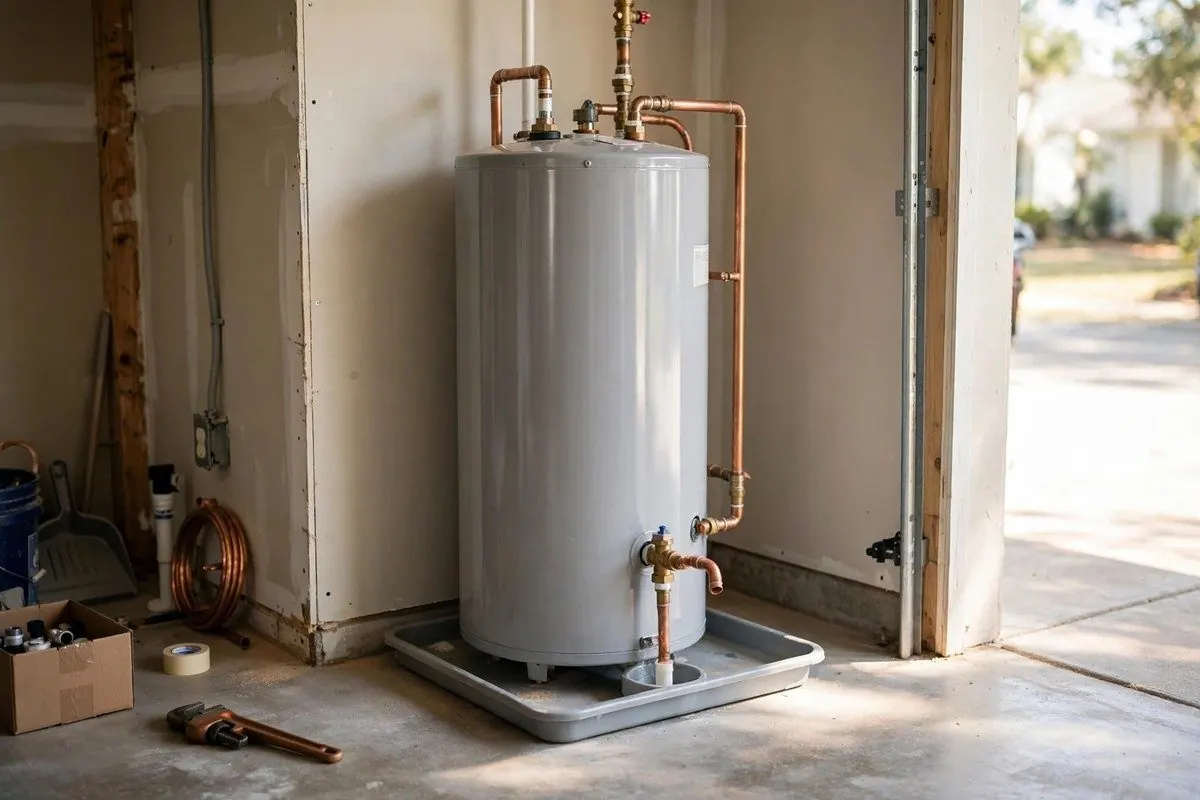
What a drip pan does and what it does not
A drip pan sits under a tank heater and collects water that escapes from a leaking tank, a weeping fitting or a relief valve discharge. It buys time. A pan with a drain sends that water to a safe place, and a pan without one only holds a small amount before it overflows.
A pan does not stop a failing tank from failing. When a tank is leaking from the shell, the water heater is at the end of its life and replacement is the real fix. A pan limits the damage while you arrange it.
Pans matter most where a leak would hurt: a heater in a closet over finished floor, in an upstairs laundry room or in a finished basement. A heater in a garage on bare concrete with a floor drain is a lower-stakes case.
What drives drip pan installation cost
Pan size and material
The pan must be wider than the heater base. Plastic and metal pans differ in price and in how they handle heat and corrosion.
Drain routing distance
A pan near a floor drain or an exterior wall is simple. A pan in an interior closet may need a long run with a proper slope.
Trap and vent requirements
Some drain connections need a trap and a vent, which adds fittings, labor and sometimes wall access.
Heater access and lifting
Fitting a pan under an existing tank often means draining it and lifting it. Doing it at replacement time is much simpler.
Add-on work during the visit
Strapping, a new relief valve discharge pipe, shutoff valves or an expansion tank change the scope and the price.
Insurance usually responds to sudden water damage more readily than to slow leaks from wear, so a pan with a good drain can make a small leak easier to catch and document. For a real number on your heater location, call us and we will price it before work starts.
Where the pan drain goes: common setups
| Setup | What it takes | Watch out for |
|---|---|---|
| Floor drain nearby | Short run from the pan, sloped to the drain | A dry floor drain trap can let sewer odor into the room |
| Out through an exterior wall | A drain line sloped to a wall opening | Winter freezing at the exit point and animals using the opening |
| Connected to the soil or waste system | A trap and vent on this drain alone | Only allowed when the code official permits, so ask first |
| No drain, pan only | A pan sitting under the heater | It holds a small amount and needs checking often |
| Pan with a leak alarm | A pan plus a battery sensor | Batteries need testing and the alarm will not move water |
Notice that the cheapest pan and the cheapest drain are not the same decision. A pan with a poor drain can be worse than no pan, because it hides a slow leak behind a quiet tray.
Planning a heater swap?
Call us and we will walk through the pan, drain, strapping and discharge pipe so the quote shows the whole job.
What Riverton homeowners should know
Utah amends the plumbing code for water heaters in Utah Code 15A-3-305. The amendment says a pan drain may connect to the soil or waste stack only when the code official permits it, and the drain must be individually trapped and vented. It also says a heater pan may receive discharge from the heater only. In practice, this means the pan drain is its own line and not a shortcut into another fixture's plumbing.
The same amendment requires water heaters to be anchored or strapped against earthquake motion, with straps in the upper and lower thirds of the heater's height. Riverton says a building permit is required for work on plumbing systems regulated by the code. Ask the Riverton building department whether your install needs one, since the city page does not say.
Sources: Utah Code 15A-3-305 water heater amendments, Riverton Building Inspections and Permits page
What a proper pan install includes
Check the location
We look at the floor below, the nearest drain options, the wall behind and the clearance around the heater.
Size and place the pan
The pan sits under the heater base with a margin on all sides, and the drain outlet faces the planned route.
Route and slope the drain
The drain line runs downhill the whole way with no sags, and it stays separate from other fixtures' discharge.
Test with water
We pour water into the pan and watch it leave through the drain, checking every joint for drips.
Add the other safety items
Strapping, relief valve discharge and shutoffs are reviewed in the same visit, not left for later.
Common pan mistakes that cost more later
Pan too small
A pan barely wider than the heater misses water that runs down the side and across the floor.
Drain with no slope
Water sits in the line instead of leaving, and the pan overflows during a real leak.
Other fixtures draining into it
A pan should catch the heater and nothing else. Piping a softener or sink drain into it hides what is actually leaking.
Never checked
A dry pan can hide a dripping fitting that has been weeping for months. Look under the heater when you do other chores.
If the pan keeps collecting water, find out where it is coming from. A weeping fitting may be a simple water heater repair, while a leaking tank means replacement. Either way, the pan should not be your long-term plan.
Adding a pan with a new heater versus later
Add a pan during a replacement
- The old tank is already out of the way.
- Drain routing is planned with the new location.
- Strapping and discharge pipe are handled together.
- One visit covers the whole job.
Retrofit under an existing heater
- The tank must be drained and lifted.
- Existing pipes may limit pan size or placement.
- It can reveal corrosion or fittings that need work.
- Often worth it only if the heater has years left.
Planning a new heater? Our water heater installation page covers what goes into a standard swap, including the pan and drain. We also dispatch to Draper and South Jordan, so neighbors can call us for the same work.
Drip pan questions answered
Not every setup does, and we will not claim a rule we cannot back up. A pan makes the most sense where a leak would damage finished floors or rooms below. Ask the Riverton building department what applies to your installation.
Floor drains are a common choice. Utah's amendment says a pan drain may connect to the soil or waste stack only when the code official permits it, and it must be individually trapped and vented. Ask before you connect it.
The relief valve discharge pipe has its own routing rules that we confirm for each install, so ask your plumber how yours is set up. Utah's amendment does say a heater pan may receive discharge from the heater only, so other fixtures should never drain into it.
Look at it a few times a year and any time you smell dampness. Water in the pan means something is leaking above it, and the source needs finding.
They are separate, but it makes sense to handle both in one visit. Utah's amendment requires the heater to be anchored or strapped, with straps in the upper and lower thirds of its height.
Shut off the cold water supply to the heater, turn off the gas or power to it, and call the 24/7 line. If you smell gas, leave the building and call Enbridge Gas Utah at 1-800-767-1689 or 911 first.