
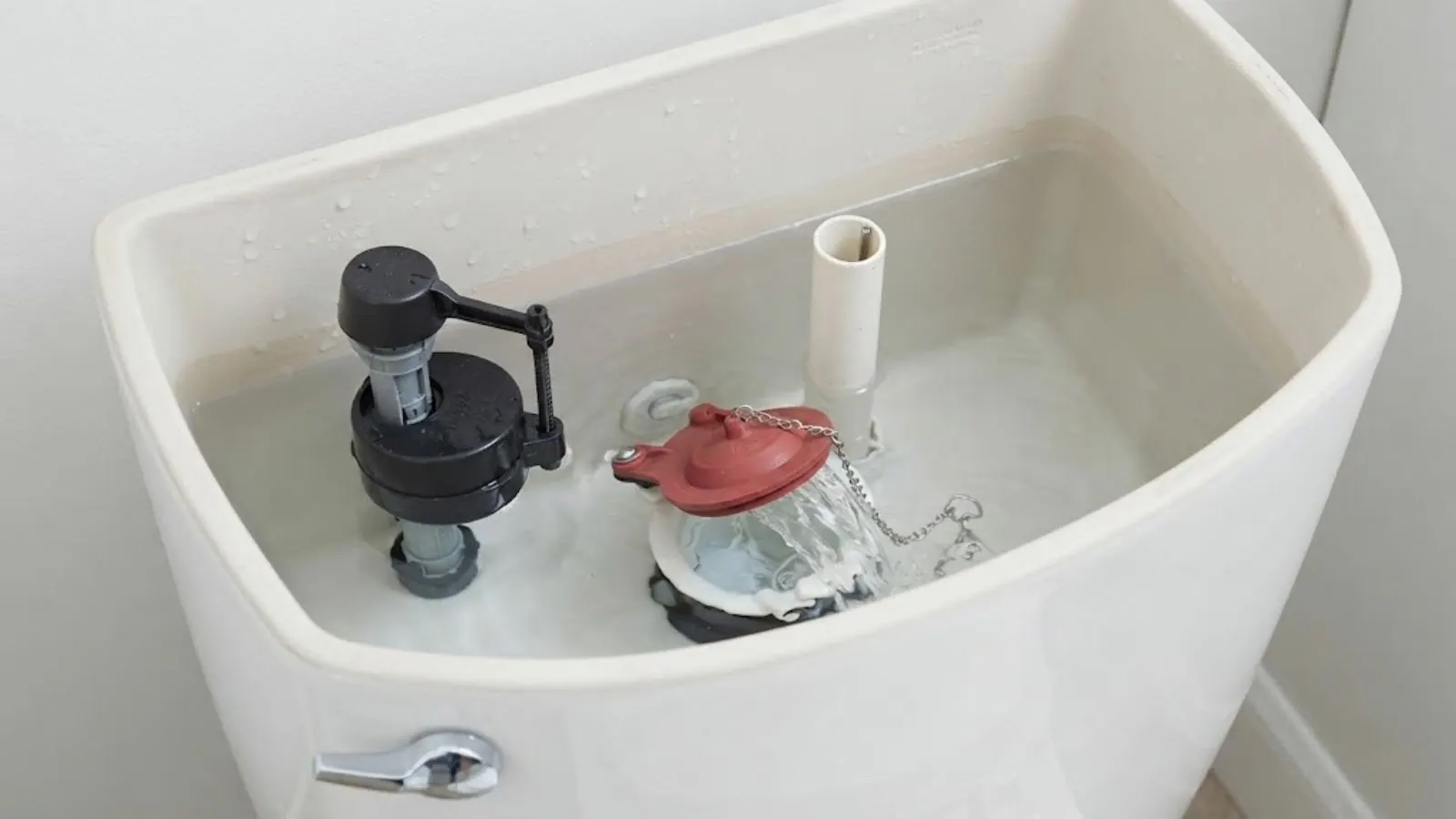
First, work out where the water is really coming from
Do not start by buying parts. Water on the bathroom floor can come from the supply line, the tank, the base of the bowl, or just condensation, and each one has a different fix.
Dry the toilet completely with a towel, including the supply line, the shutoff valve and the underside of the tank. Wrap dry toilet paper around each joint and wait. The first piece of paper that darkens points to the source.
| Where it is wet | Likely cause | Who usually fixes it |
|---|---|---|
| Under the tank, dripping from the bolts | Worn tank bolt washers or the tank-to-bowl gasket | Confident DIYer or plumber |
| At the shutoff valve or hose connection | Loose compression nut, worn washer or tired supply line | DIYer, plumber if the valve itself drips |
| Whole tank surface beading and dripping | Condensation, not a leak | Usually no repair needed |
| Around the base of the bowl on the floor | Failed wax ring or flange problem | Plumber, since the toilet must come up |
| Water level rising to the overflow tube | Fill valve not shutting off | DIYer, quick part swap |
| A line or crack running down the tank | Cracked porcelain | Replace the tank or the toilet |
The dye test that finds a silent leak
A leak you can hear but not see is usually inside the toilet, where water slips from the tank into the bowl past a worn flapper. It wastes water without leaving a puddle, and it is the most common reason a toilet keeps refilling by itself.
Add color to the tank
Lift the lid and put several drops of food coloring into the tank water. Do not flush.
Wait and watch the bowl
Leave the toilet alone for a good while. If color shows up in the bowl, water is leaking past the flapper or flush valve seat.
Rub the flapper edge
Turn off the water at the shutoff valve, flush to empty the tank, and run a finger around the flapper's sealing edge. Slime, grit or mineral crust there means the seal is not closing cleanly.
Check the chain
A chain too tight holds the flapper slightly open. One too loose can get caught under it. Aim for a little slack so the flapper drops fully.
Replace the flapper if the edge is worn
A new flapper is a small, inexpensive part that clips on the overflow tube posts. Match it to your flush valve opening before you buy.
Which parts fail and how to deal with each
The flapper and the flush valve seat
The flapper is a rubber stopper that lifts when you flush and drops back to seal the tank. Rubber hardens and warps over time, and mineral buildup can keep it from sealing flat. If cleaning the seat with a non-scratch pad does not stop the dye from leaking through, replace the flapper.
The fill valve
The fill valve refills the tank after each flush. When it fails, water keeps running into the overflow tube and the tank never fully shuts off. You will hear a hiss or a trickle. Adjusting the float or replacing the whole fill valve assembly usually fixes it, and it is one of the easier jobs to do yourself.
Tank bolts and the tank-to-bowl gasket
Two long bolts with rubber washers clamp the tank to the bowl. If water drips from under the tank, the washers have usually hardened or the gasket has flattened. Turn off the water, empty the tank, and replace the bolts, washers and gasket together. Tighten them evenly and gently, because overtightening cracks porcelain.
The supply line and shutoff valve
A braided supply line that is kinked, corroded at the nut, or simply old can weep at the connection. Replacing it is a hand-tool job. If the shutoff valve itself leaks around its stem or will not close, the repair becomes a valve repair job, and a stuck valve you force can break. That is the time to call.
What Riverton homeowners should know
Riverton buys all of its drinking water from Jordan Valley Water Conservancy District. Riverton's 2022 water quality report lists average hardness of about 190 mg/L, roughly 11 grains per gallon. Mineral-rich water can leave scale on rubber and plastic parts over time, so check the flapper edge and fill valve for crust. Test your own tap, because water quality can differ from the report year to year.
A toilet leak is a fixture problem, not a water-line break. For a spraying or flooding line in the street or at the meter, Riverton lists after-hours water emergency numbers of 801-558-1814 or 801-254-0704. The city says most spraying water calls turn out to be sprinkler line breaks that the property's ball valve can stop. For a leaking toilet, close the valve behind the toilet first.
Sources: Riverton City 2022 water quality report, Riverton City water pages
Toilet still leaking after the parts swap?
If the dye test, the flapper and the bolts all check out and water still shows up, call the 24/7 line. We will track down what the quick checks missed.
What to do right now if the toilet is overflowing or the tank is pouring
Reach behind the toilet and turn the shutoff valve clockwise until it stops. That cuts the supply and ends most active leaks immediately. If the valve spins freely or will not turn, shut the main water valve to the house instead.
Lift the tank lid and push the float or flapper down if the water is rising toward the rim. Then mop up. Standing water on a bathroom floor seeps under flooring and can ruin the subfloor if left for days.
- Close the shutoff first.Everything else is easier once the water is off.
- Do not flush again.A flush on top of a blocked or flooded bowl only adds volume.
- Kill the power near the wet area.If outlets or fixtures sit near standing water, switch off that circuit at the panel before wading in.
- Photograph the damage.Take pictures of wet areas and the failed part before you clean, in case an insurance claim follows.
DIY fix or a plumber? A plain-language rule
Reasonable to do yourself
- Replacing a flapper, fill valve or flush handle
- Swapping a braided supply line and tightening the nut
- Replacing tank bolts and washers with the water off
- Adjusting the chain or float height
Call a licensed plumber
- Water at the base of the bowl, which means a wax ring or flange problem
- A shutoff valve that leaks, sticks or will not turn
- Cracked porcelain on the tank or the bowl
- A toilet that rocks, a floor that feels soft, or a leak that returns after repairs
The wax ring is the big dividing line. Pulling a toilet to reset it means disconnecting the supply, lifting a heavy fixture, and resealing a connection to the drain. A bad flange or a damaged floor under it turns a short job into a repair that needs the right parts and a steady hand.
Keeping the next leak from starting
Most tank leaks are wear, and wear is slow. Once a year, look inside the tank, press the flapper edge with a finger, and check the supply line for stains. Replacing a soft flapper before it fails costs less than the water it would waste.
If you are also seeing a dripping sink or a stubborn faucet in the same bathroom, a visit that covers all of them saves a second trip. We also dispatch to Herriman and South Jordan, and the advice is the same there: older rubber parts tend to wear out around the same time.
Rules and sources behind this page
Toilet repairs sit under the plumbing code Utah adopts. Utah Code 15A-2-103 adopts the 2024 International Plumbing Code (IPC) as the state plumbing code, effective July 1, 2026, with Utah amendments on top.
Riverton's 2022 water quality report lists average hardness of about 190 mg/L, roughly 11 grains per gallon. According to general plumbing guidance, mineral buildup can stiffen flappers and fill valves, so test your tap and inspect parts that feel gritty.
Toilet tank leak questions
The usual causes are worn tank bolt washers, a flattened tank-to-bowl gasket, or a loose supply line connection. Dry everything and wrap toilet paper around each joint to see which one gets wet first. Cracked porcelain is less common but possible.
Use the dye test. Put food coloring in the tank and wait. If color appears in the bowl without a flush, the flapper or its seat is leaking.
No. Cold water inside the tank can cause condensation on the outside surface, especially in humid rooms. If the supply line and bolts stay dry under a paper towel test, you are likely seeing condensation, not a leak.
Sealants rarely fix a tank leak for long, because the leak comes from a worn washer, gasket or crack. Replace the failed part instead. Caulk over a crack hides the problem and tends to fail.
Repair if the problem is a flapper, fill valve, bolts or supply line. Replace if the porcelain is cracked, the toilet keeps clogging, or the fixture is old enough that parts are hard to match. A plumber can help you weigh that using the condition of the toilet itself.
Riverton's 2022 water report lists average hardness of about 190 mg/L, so scale on flappers and valves is plausible. We would not blame water for every failure. Look at the part first, and test your own tap if you want a number for your home.